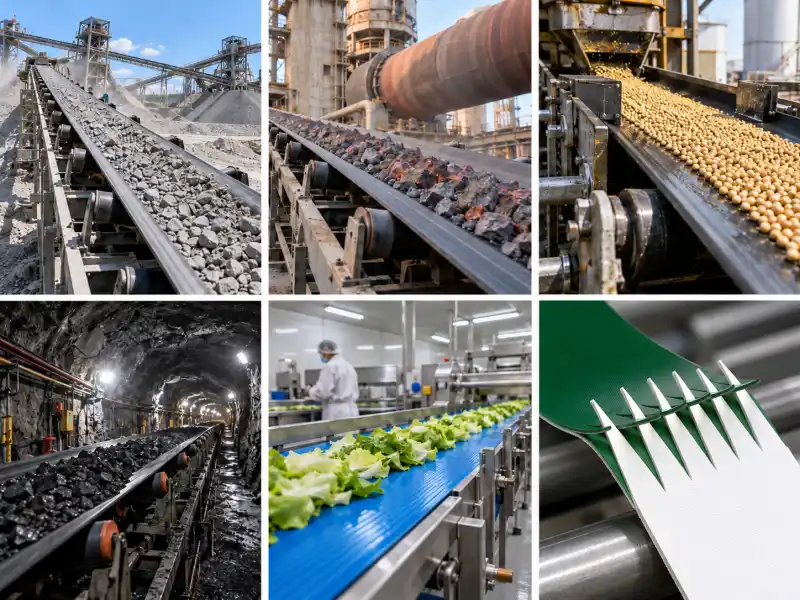
Conveyor belt material is a broad term. It may refer to the polymer on the working surface, the fabric or steel cord that carries tension, the bonding layers that hold the belt together, or the compound used at the splice. These choices are related, but they are not interchangeable. A cover compound can be specified without changing the carcass, and a carcass can be specified without changing the cover. This guide explains what each part does, how duty conditions point toward different material options, and how to describe a conveyor so that the recommendation fits the application.
1. What Conveyor Belt Material Includes
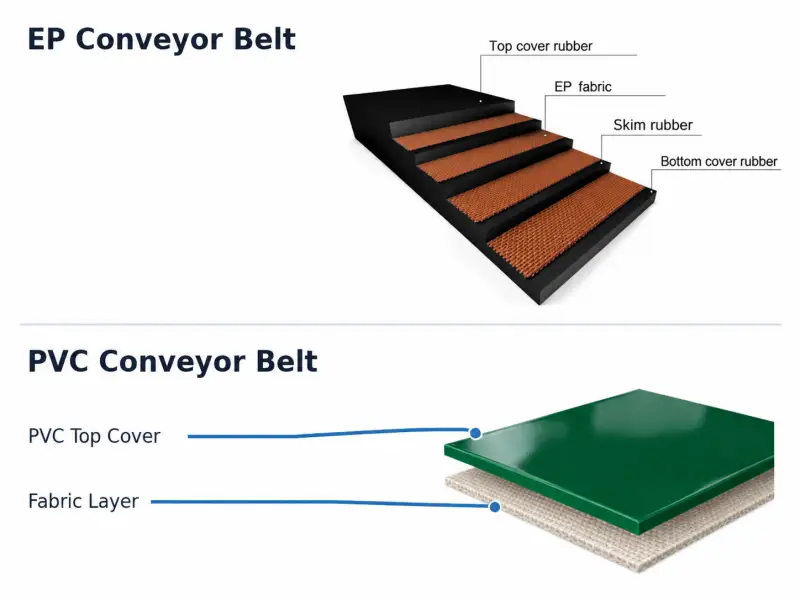
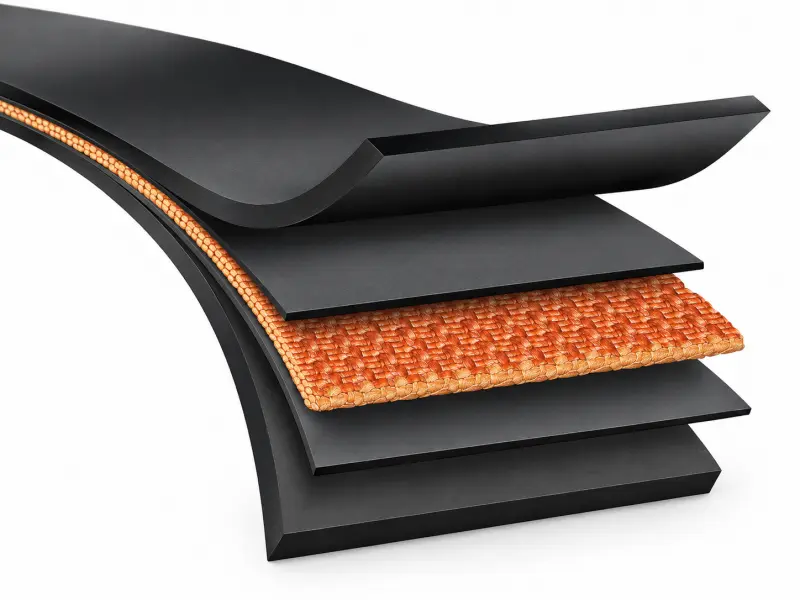
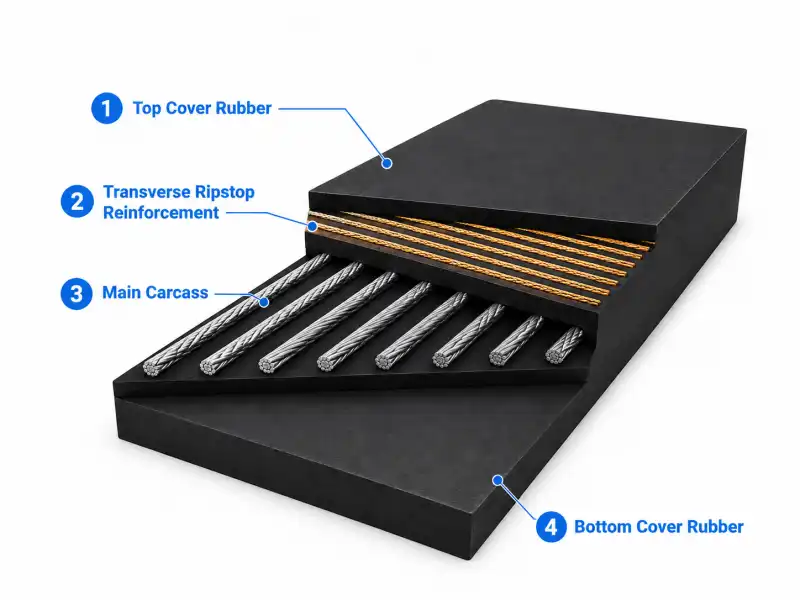
In a rubber belt, the material system has four parts: the cover, the carcass, the bonding layers and the splice. In a PVC or PU belt, the working surface is a thermoplastic sheet rather than a rubber cover. The parts are selected together because each one changes the limits of the others.
1.1 Top and Bottom Cover Rubber
The top cover contacts the material. It provides abrasion resistance, impact resistance, heat resistance, oil resistance and cleanability. The bottom cover runs against the rollers and pulleys; it affects friction, tracking and return-run wear. The top and bottom covers can use different compounds and thicknesses. A heavy-duty belt often has a thicker, harder top cover and a thinner bottom cover.
1.2 Fabric or Steel Cord Carcass
The carcass carries the operating tension. EP and NN fabric belts use woven plies; steel cord belts use parallel cords. The carcass determines the full-thickness tensile strength, elongation, impact resistance, minimum pulley diameter and splice method. A cover change does not correct a carcass that is understrength or too stiff for the pulley layout.
1.3 Bonding Layers, Edges and Splice
Bonding layers keep the cover and carcass together. Edge rubber protects the cut edges. The splice compound must be compatible with the belt compound, because the joint is part of the material system. A splice made with the wrong compound can fail before the cover reaches the end of its wear life.
1.4 Limits of Material Selection
Material selection cannot correct an unfavorable loading point, off-center loading, a worn pulley, poor tracking, an over-tight scraper or a splice installed in wet conditions. Because the belt travels in a loop, damage from a fixed component usually appears as a repeating pattern along the belt rather than at one spot. Inspect the conveyor before changing the compound.
Part | Function | Data to confirm |
Cover rubber | Contacts the material and resists wear, heat, oil or chemicals | Compound, grade, top and bottom cover thickness |
Carcass | Carries tension and controls elongation | EP, NN or steel cord; strength class; ply count |
Bonding layer | Holds cover and carcass together | Adhesion test data and belt construction |
Edges and splice | Protect cut edges and join belt ends | Edge type, splice compound and splice method |
2. Duty Conditions That Shape Conveyor Belt Material Choice
The first step is to exclude materials that cannot survive the environment. The second is to compare the remaining options on service life, splice compatibility and cost.
2.1 Abrasion, Impact and Material Characteristics
Abrasion depends on the hardness, sharpness and lump size of the material, and on the belt speed and drop height. Hard, sharp, angular material carried at high speed wears the cover faster. Soft, wet or sticky material creates a different problem: it can adhere to the cover, build up on pulleys and make cleaning difficult. Cover hardness, thickness and tear resistance matter alongside the compound.
2.2 Heat, Cold and Continuous Duty
Heat ages rubber. The cover hardens, shrinks, cracks and eventually breaks away. Cold makes some compounds stiff and prone to cracking. Continuous operation at elevated temperature is more demanding than short peaks because the cover has less time to recover. The temperature at the loading point, the material temperature and the ambient temperature should be recorded separately.
2.3 Oil, Chemicals and Cleaning Agents
Oil swells natural rubber and SBR. NBR and some PVC or PU compounds resist better. Cleaning agents can be as aggressive as the conveyed product, so record the concentration, temperature and contact time. A compound that resists the product may still fail in the cleaning step.
2.4 Flame Resistance and Anti-Static Performance
Flame resistance and anti-static performance are separate properties. Flame resistance limits flame spread and is tested under specified conditions. Anti-static performance controls the buildup and dissipation of static charge, usually expressed as surface resistance or resistivity. A belt can be flame-resistant without being anti-static, or anti-static without being flame-resistant. State both requirements separately and ask for the test method and result.
2.5 Food Contact and Hygiene
Food contact depends on every material that can touch the food: the working surface, carcass, adhesives, edges and splice. White rubber belts are common in sugar plants and similar bulk food operations. PVC and PU food-grade belts are common in snack food, bakery and packaging plants. The two types are cleaned and joined differently, so the hygiene plan has to match the belt construction.
2.6 Tension, Pulley Diameter and Splice
The required tension comes from the conveyor duty: throughput, speed, lift, friction and starting conditions. Apply the required safety factor, then select a carcass that provides the resulting full-thickness tensile strength. EP and NN fabric belts are the most common choice; fabric type and ply count determine the rating. Steel cord is used for long, high-tension conveyors. Pulley diameter and belt thickness set the flex fatigue limit, and the splice must match the carcass and the available equipment.
Duty signal | Main stress | Material property to check |
Hard, sharp, angular material | Cover wear and cutting | Abrasion resistance, tear strength, cover thickness |
Large lumps or high drop | Impact on cover and carcass | Impact resistance, carcass toughness |
Soft, wet or sticky material | Adhesion, carryback and cleaning | Surface finish, release behavior, cleaning method |
Hot material | Cover aging, hardening and cracking | Heat resistance, heat-aging data |
Oil or grease | Swelling and softening | |
Washdown or chemicals | Swelling, hydrolysis or extraction | Chemical compatibility |
Food contact | Hygiene and cleanability | Contact-layer compliance and splice design |
Long distance or high tension | Carcass and splice | Full-thickness tensile strength, splice method |
3. Rubber Conveyor Belt Material: Compounds, Cover Properties and Carcass
Rubber belts are selected by cover properties first: abrasion resistance, heat resistance, oil resistance, flame resistance and cleanability. The compound name is a shorthand for those properties. Two compounds with the same name can perform differently if the formulation, cure and cover thickness differ.
3.1 Abrasion Resistance: NR, SBR and Blends
Natural rubber provides high elasticity, good tear strength and good abrasion resistance. SBR provides consistent abrasion resistance at lower cost. Blends of NR and SBR balance toughness, wear and cost. These compounds are common in aggregates, sand, gravel and general bulk haulage. They are not suitable for hot clinker, oil-soaked scrap or continuous ozone exposure.
3.2 Heat Resistance: EPDM and Heat-Aged Covers
EPDM resists heat aging, ozone, sunlight and water. It is common in hot, dry duty such as cement clinker, coke, ash and foundry sand. EPDM has poor resistance to oil and hydrocarbons. A heat-resistant belt also needs a compatible carcass, cover thickness and splice; a heat-resistant cover with a standard splice can still fail at the joint.
A cement plant in Southeast Asia conveyed clinker on a general-purpose abrasion-resistant rubber belt. The cover developed a fine network of cracks rather than the smooth wear pattern expected from abrasion. The plant replaced it with a heat-resistant rubber cover selected for the clinker temperature and cooling condition. The cracking stopped, and the belt returned to a normal replacement cycle.
The failure pattern is useful evidence. Fine crazing is consistent with heat aging; gouging with impact; polishing with fine abrasion or slip. The pattern should be read together with service hours, temperature history and cleaning practice.
3.3 Oil Resistance: NBR
NBR resists mineral oil, grease and many fuels. It has moderate heat resistance and poor ozone and outdoor aging resistance. It is used for oily scrap, machined parts, recycling lines and oil-bearing grain or biomass. NBR should not be used as a general heat-resistant compound.
3.4 Flame, Outdoor Aging and Chemical Exposure: CR and CSM
CR, or neoprene, resists flame spread, outdoor aging (sunlight, ozone, rain and temperature cycling) and moderate oil exposure. CSM, or hypalon, adds heat, ozone and chemical resistance and is available in light colors. Both are specialty compounds. Ask for the actual compound, the test method and the test result rather than a generic label.
3.5 Cover Grades DIN-W, DIN-X, DIN-Y and DIN-Z
DIN 22102 groups textile-belt covers into grades W, X, Y and Z. The letters describe abrasion and strength classes. W has the lowest abrasion loss. X has the highest tensile strength. Y is a general-purpose grade. Z is intended for lighter stress. The grades are not a simple ranking: W may be better for wear, while X may be better for tearing. A wear grade does not define heat resistance or oil resistance, so those properties need separate data.
3.6 EP, NN and Steel Cord Carcasses
EP uses polyester warp and nylon weft. It stretches less than NN and handles moisture well. NN uses nylon in both directions; it has higher elongation but good impact and flex fatigue resistance, so it needs more take-up travel. EP and NN are the most widely used carcasses. Steel cord has the highest tensile strength and the lowest elongation; it is used for long, high-tension conveyors with large pulleys and vulcanized splices. The carcass is selected by the required full-thickness tensile strength, then checked against the minimum pulley diameter and splice method.
Cover property | Common compounds | What it provides | Limits |
Abrasion resistance | NR, SBR, blends | Elasticity, tear strength and wear resistance | Heat aging and oil swelling |
Heat resistance | EPDM, heat-resistant SBR or NR blends | Retention of properties after heat aging | EPDM swells in oil; blends have a lower heat ceiling |
Oil resistance | NBR, CR | Resistance to mineral oil and grease | Heat, ozone and outdoor aging |
Flame and outdoor aging | CR, CSM | Flame-spread resistance, ozone and sunlight resistance | Cost and specialty compounding |
Chemical resistance | CSM, CR | Selected acid, alkali or oxidizing exposure | Verify the actual medium with immersion data |
Carcass | Tensile position | Elongation | Impact and flex | Pulley size | Splice |
EP fabric | Medium to high | Low | Good | Medium | Stepped or finger vulcanized |
NN fabric | Medium | Higher | Very good | Smaller possible | Stepped or finger vulcanized |
Steel cord | Very high | Very low | Good with correct design | Large | Multi-stage vulcanized |
3.7 Limits of Rubber Belting
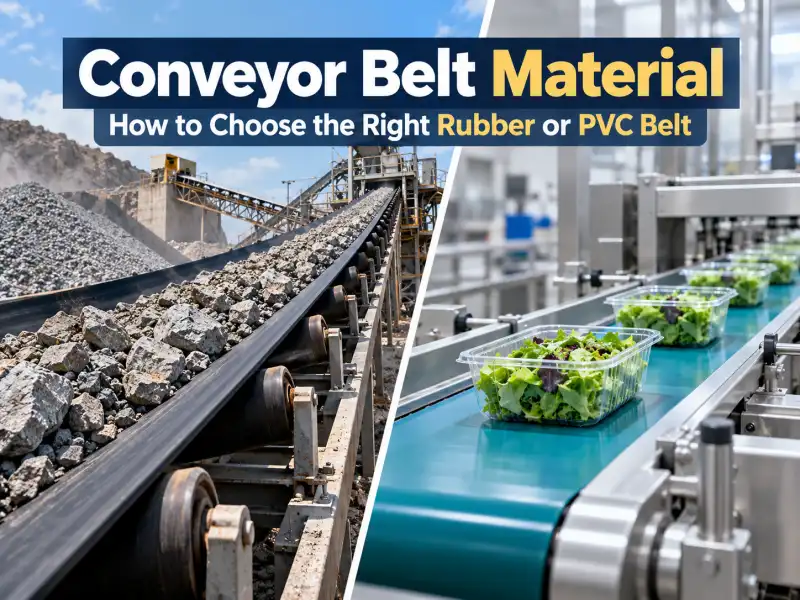
Rubber is not the best choice for thin, light belts on small pulleys, cleanroom and logistics sorters, wet washdown lines and food-contact belts that need frequent cleaning. PVC or PU usually fits those duties better. Rubber is also unnecessary on short, low-tension lines where a lighter belt can do the same work.
4. PVC and PU Conveyor Belt Material: Where They Fit
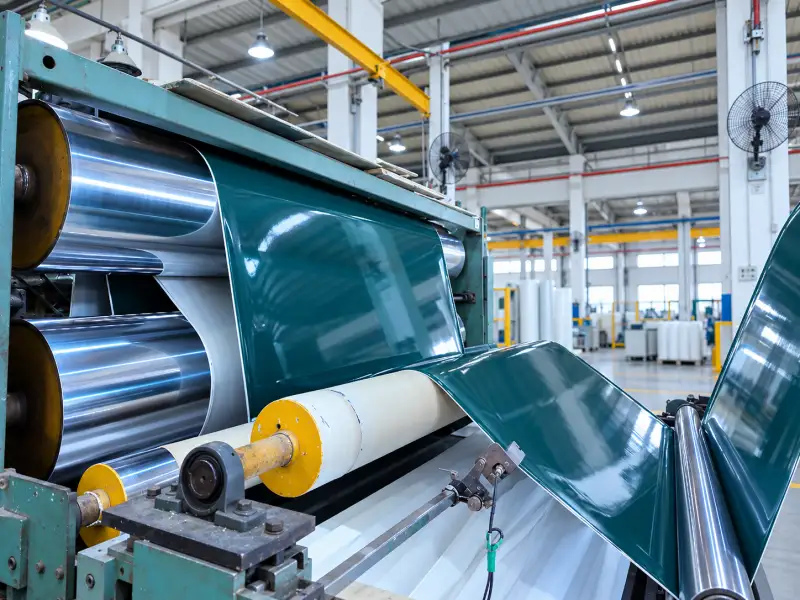
PVC and PU belts are used for light-duty conveying. Their working surface is a thermoplastic sheet, and the belt is usually joined by finger splicing and welding. They are common on small pulleys, clean lines, food-contact lines and packaging equipment.
4.1 PVC and PU Working Surfaces
PVC is the lower-cost thermoplastic option. It is stiffer, has good dimensional stability and can be formulated for food contact. PU has better abrasion resistance, better oil and fat resistance, and better flexibility at low temperature. Because the working surface is a thermoplastic sheet, the term “cover compound” does not apply in the same way as it does to a rubber belt.
Some PU grades are sensitive to hydrolysis in hot, humid conditions. For hot-water washdown in a tropical climate, specify a hydrolysis-resistant grade and confirm it in writing.
4.2 Food-Contact Belts
Food-contact belts fall into two broad groups. White rubber belts are used in sugar plants and similar bulk food operations; they have a rubber cover and are usually vulcanized. PVC and PU food-grade belts are common in snack food, bakery and packaging plants; they have a thermoplastic working surface and are usually finger-spliced and welded. For either type, the declaration of compliance must cover every contact layer: surface, carcass, adhesive, edge and splice.
Hygiene also depends on geometry. Open fabric edges, exposed carcass, rough splices and cleats create traps for food residue and cleaning water. A smooth surface with a poor splice is not a hygienic belt.
4.3 Anti-Static, Cleats, Sidewalls and Guides
Anti-static performance is measured as surface resistance or resistivity on the finished belt. A dissipative belt still needs correct grounding. Cleats, sidewalls and guides are welded or bonded to the belt. Each attachment is a stress point and a cleaning point, and it changes flexibility and pulley requirements.
4.4 Cleaning and Chemical Compatibility
Cleaning agents, sanitizers, steam and hot water affect polymers in different ways. Check concentration, temperature and contact time against the supplier’s compatibility data. A food-grade belt is not automatically resistant to a strong cleaning chemical, and a chemical-resistant belt is not automatically food-safe.
4.5 Limits of PVC and PU Belting
PVC and PU are unsuitable for hot clinker, coarse ore, large lumps, high tension, long distance and sharp scrap. They are also unsuitable when the working-surface temperature exceeds the sheet’s limit, even if the exposure is only part of the cycle. In those cases, a rubber belt is the safer starting point.
| Property | PVC | PU |
| Relative cost | Lower | Higher |
| Abrasion resistance | Good | Better |
| Oil and fat resistance | Moderate | Better |
| Flexibility at low temperature | Moderate | Better |
| Hot, humid hydrolysis risk | Lower | Grade-dependent |
| Food-contact options | Available | Available |
| Typical splice | Finger splice and weld | Finger splice and weld |
| Typical duty | Logistics, packaging, light food lines | Food, oil contact, precision sorting |
5. Rubber vs PVC Conveyor Belt Material: A Side-by-Side View
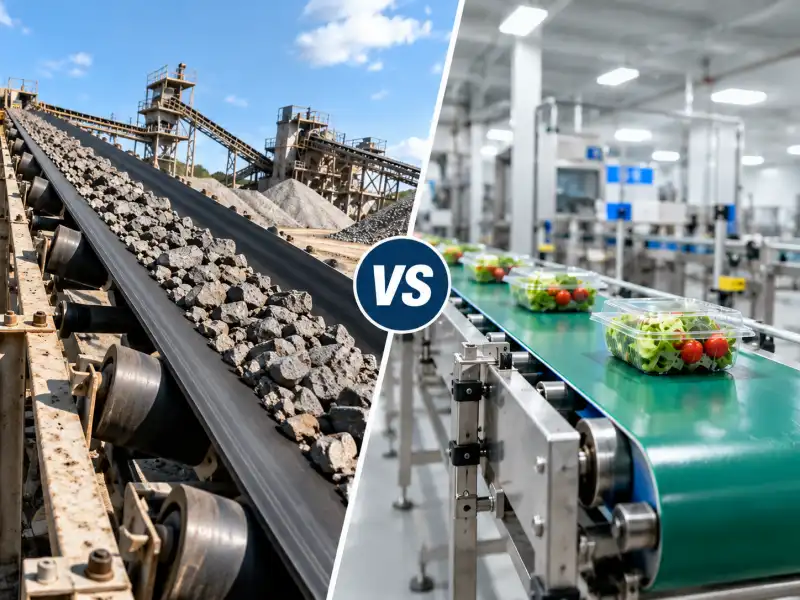
The comparison is between heavy, abrasive, hot or oily duty and light, clean, wet or food-contact duty. The table gives a first-pass direction; the final choice still depends on the calculated tension, pulley layout and splice.
Decision factor | Rubber | PVC or PU |
Load and impact | High | Low to medium |
Abrasion | High with the right cover | Good on light duty |
Heat | Heat-resistant compounds available | Limited by the polymer |
Oil and grease | NBR or specialty compounds | PU often better than PVC |
Food contact | White rubber food belt with vulcanized splice; heavier | PVC/PU food-grade belt with welded splice; lighter |
Cleaning and washdown | Possible, with attention to edges and splice | Common |
Splice | Vulcanized | Finger splice and weld |
Pulley diameter | Larger | Smaller |
Belt weight | Higher | Lower |
Typical industry | Food, logistics, packaging, electronics |
If one conveyor handles both heavy and light duty, splitting the line is usually clearer than forcing one belt to cover both. Where a split is not possible, select for the dominant risk and inspect the transition points more often.
6. How to Specify Conveyor Belt Material
A useful specification starts with the duty and ends with a belt construction that can be checked against the conveyor. Over-specification adds cost, weight and pulley load; under-specification moves the failure risk to the belt.
6.1 Duty Data Before Belt Selection
Send us the operating data first: throughput in TPH, material type and maximum lump size, bulk density, moisture, belt speed, loading-point temperature, ambient temperature, incline, pulley diameters, and any oil, chemical or cleaning exposure. If you already have a belt specification, include bandwidth, fabric type (EP or NN), strength class, total thickness, top and bottom cover thickness, ply count, rubber grade or standard, and total belt length. If you do not have a specification, send the operating data and the application; an engineer can calculate the belt requirement from those inputs. Complete duty data reduces the number of assumptions in the recommendation.
6.2 Wear Patterns and Service History
Wear patterns are clues that need context. Uniform thinning over a long service life may be normal abrasion. Polishing can come from fine material, a soft cover or slip. Gouging may be impact, a sharp lump or a loading problem. Cracks may be heat aging, ozone attack or flex fatigue. Before changing the compound, review service hours, throughput changes, temperature history, cleaning chemicals, splice condition, pulley condition and tracking. The same pattern after a few weeks and after two years points to different causes.
6.3 Carcass Strength and Pulley Geometry
The carcass has to meet the required full-thickness tensile strength, which comes from the calculated operating tension and the safety factor. Fabric type and ply count determine that strength; a thicker belt with more plies is not automatically better. Minimum pulley diameter, transition distance and belt thickness set the flex fatigue limit. A fabric belt with too many plies can fail from flex fatigue on a small pulley, even though it is not a steel cord belt. We check the calculated tension, the proposed carcass rating, the pulley diameter and the splice method as one set.
6.4 Edge, Splice and Accessories
Confirm the edge type, splice compound, splice method, cleat or sidewall attachment and guide position. These details determine whether the belt can be cleaned, whether the splice can carry the duty and whether the belt tracks. The splice should be specified with the belt, not added after the belt is chosen.
6.5 Comparable Cost Items
Compare the quoted price per meter, the splice cost, and any quantifiable extras such as edge treatment, cleats, packaging or freight. Use the same specification and the same scope for each quote. A detailed total-cost model is difficult to apply in practice because operating costs are estimates, and time cost is especially hard to measure. Keep the comparison to items that appear on the quotation and can be verified.
7. Conveyor Belt Material Mistakes That Cause Early Failure
Most early failures leave evidence. The evidence is visible before the belt is removed if someone looks for it.
Selection error | Consequence | What to check |
Buying by price or color | Cover property does not match the duty | Abrasion, heat and oil requirements |
Using one belt for mixed duties | Compromise in every section | Split the line or select for the dominant risk |
Ignoring temperature and cleaning agents | Hardening, cracking or swelling | Temperature history and chemical exposure |
Choosing the carcass by habit | Stretch, impact damage or flex fatigue | Full-thickness tensile strength and pulley size |
Treating the splice as an accessory | Joint fails before the cover | Splice compound, method and equipment |
Attributing mechanical damage to the compound | Repeating damage pattern along the belt | Loading, tracking, scrapers and pulleys |
Material selection is necessary but not sufficient. A cut at the loading point, wear along one edge or a repeat mark from a fixed idler will appear again on the next belt unless the conveyor condition is corrected. On the belt, these defects usually repeat at intervals related to the belt length and the position of the fixed component.
8.Conclusion
Conveyor belt material is a system of cover, carcass, bonding layers and splice. Start with the duty, select the cover properties for the wear mode, and confirm the carcass against the calculated tension and pulley layout. Compare quotations on the same specification and the same scope. A precise duty description gives the engineer a better basis for the recommendation.
9.FAQ
9.1 Why can two belts with the same DIN cover grade perform differently?
DIN 22102 sets minimum classes for abrasion and strength, but it does not fix the full formulation, cure, cover thickness or splice quality. Two belts can meet the same grade and still differ in heat aging, oil resistance, cut resistance and adhesion. The grade is a starting point for comparison; the datasheet, test reports and application history decide whether the belt fits the duty.
9.2 When is EPDM the right heat-resistant compound?
EPDM is a strong choice for continuous hot, dry duty with ozone, sunlight or water exposure, such as clinker, coke and ash. It is a poor choice when oil, fuel or hydrocarbon contact is possible, because EPDM swells. At moderate heat without oil, a heat-resistant SBR or NR blend may be more cost-effective. The temperature history and the chemical exposure decide between them.
9.3 How does belt speed change the material requirement?
Higher belt speed increases the number of impacts per hour, the wear rate and the heat generated in the cover and splice. It also raises the required tension for the same throughput and changes the material trajectory at the transfer points. A speed increase may call for a tougher cover, a stronger carcass, a larger pulley or a different splice, so it should be reviewed as a system change.
9.4 White rubber food belt or PVC/PU food belt: how do they differ?
White rubber food belts have a rubber cover and are usually vulcanized. They suit bulk food operations such as sugar plants, where the belt must resist heat, cleaning and heavy load. PVC/PU food belts have a thermoplastic working surface and are usually finger-spliced and welded. They are common in snack food, bakery and packaging lines, where light weight and cleanability matter. The cleaning chemicals and temperature range determine which type fits.
9.5 Why can a belt that meets the tensile rating still fail on a small pulley?
The tensile rating describes full-thickness strength, not bending fatigue. A belt with many plies or a thick cover can meet the tensile requirement and still exceed the flex fatigue limit on a small pulley, especially at high speed or with a short transition. Check the minimum pulley diameter, belt thickness, ply count and splice design together with the calculated tension.
9.6 What is the risk of increasing cover thickness to extend wear life?
A thicker cover can extend wear life in a high-abrasion zone, but it also adds weight, reduces flexibility and increases the load on pulleys and splices. On a small pulley or a tight transition, the thicker belt may fail from flex fatigue before the extra cover pays back. Increase thickness only after the wear mode, pulley geometry and splice capacity have been checked.