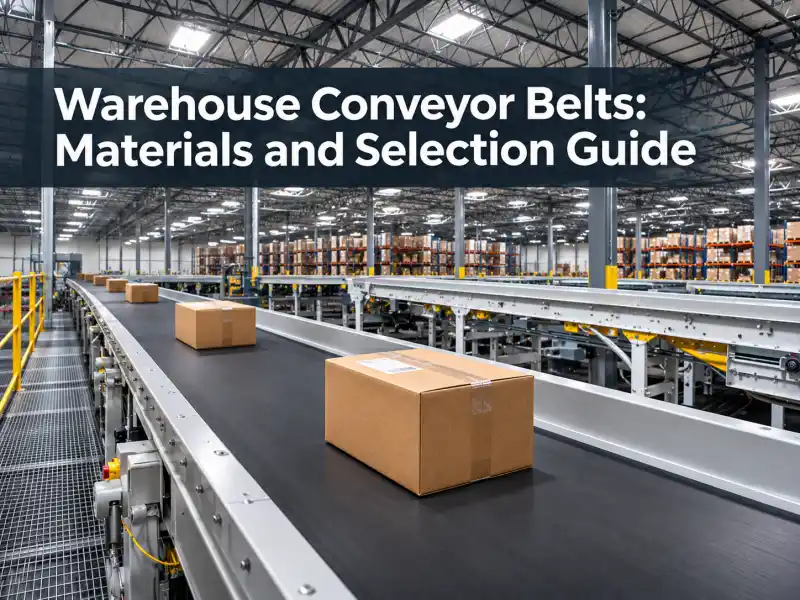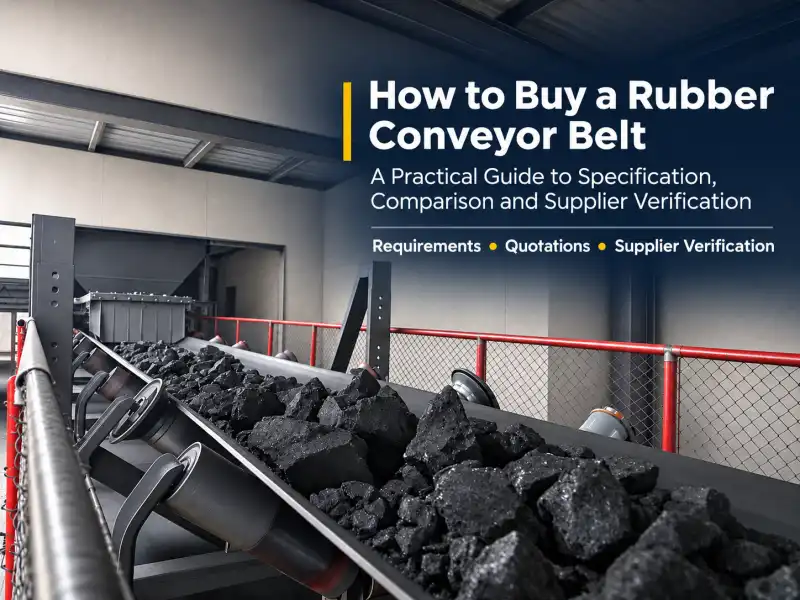
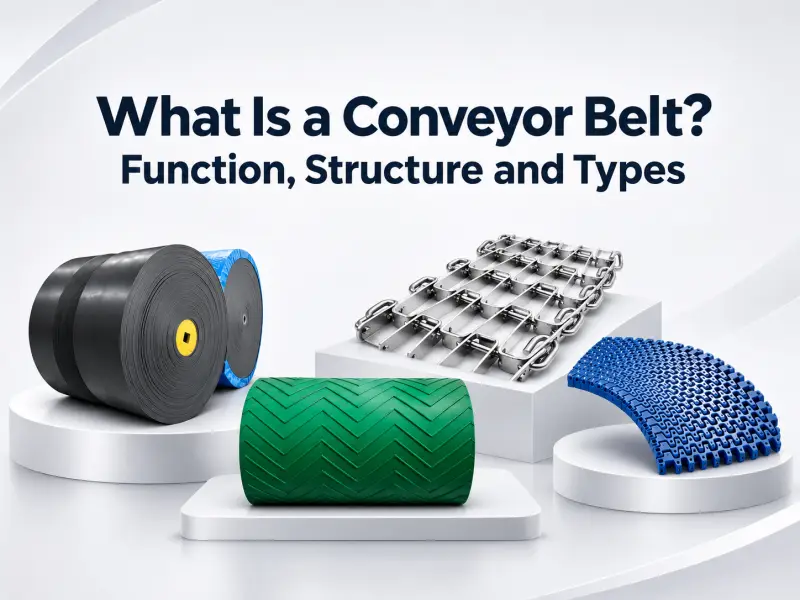
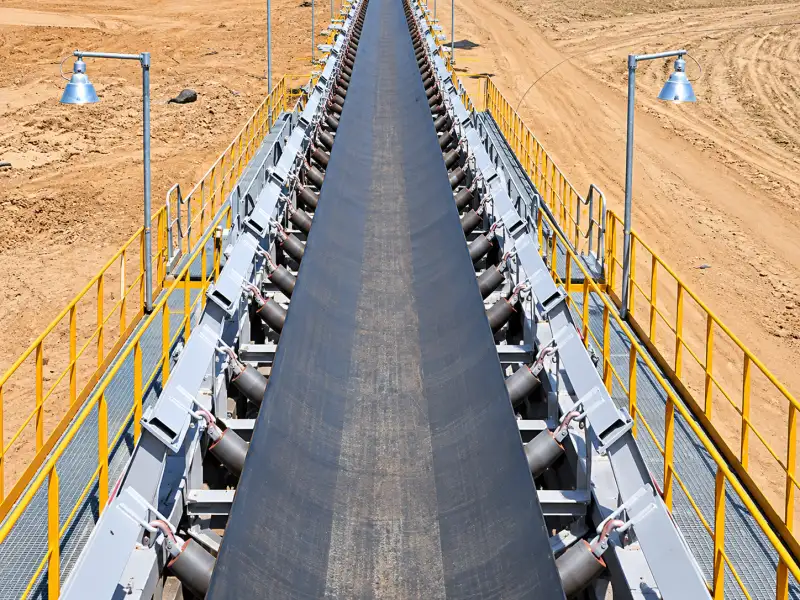
A conveyor belt is a continuous flexible surface that moves bulk material, parts or packaged products along a defined route. Rubber, PVC and PU belts commonly rely on pulley friction, while modular belts use sprocket engagement. The drive method affects tension, slip, support and the belt construction you specify.
1. What a Conveyor Belt Does
The conveyor belt performs several functions in the same operating cycle:
Function | Physical requirement | Observable consequence when unmet |
Support the product | A stable carrying surface with suitable friction, texture or open area | Product rolls, slips, falls through the belt or is damaged |
Transmit or receive drive force | Tensile members, friction surface or sprocket-engagement geometry | The belt slips, stretches or loses speed |
Bend around route ends | Flexibility compatible with pulley or sprocket diameter | Covers crack, plies fatigue or modules and rods become overloaded |
Resist product exposure | Suitable rubber compound, polymer, alloy or modular material | The belt wears, softens, cracks or corrodes |
Maintain a stable route | Controlled elongation and suitable edge construction | The belt becomes slack, shifts sideways or contacts structure |
Return for the next load | A surviving carrying surface, back surface, edges and joint | Carryback, edge damage or joint failure disrupts the next cycle |
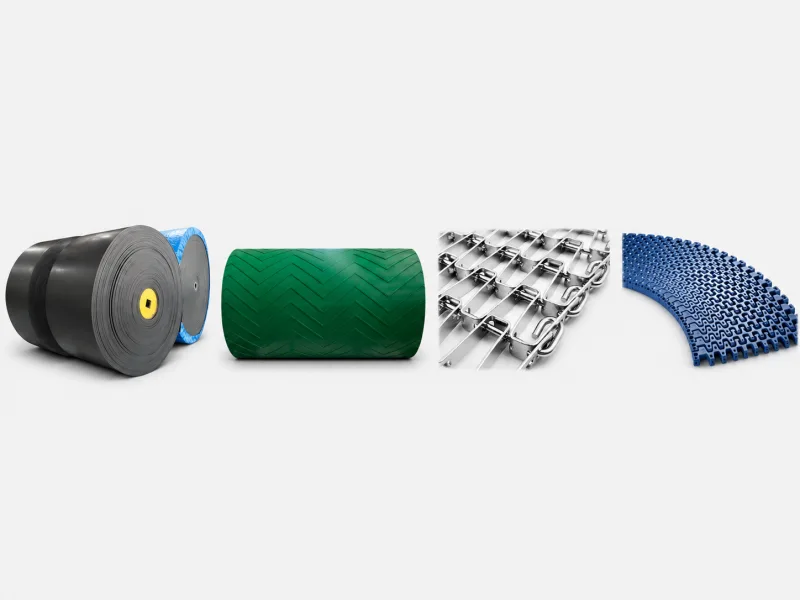
The belt combines a load-supporting surface with a separate tensile or linking structure. Rubber belts use a carcass to carry tension. Modular belts use interlocked modules and hinge rods. Metal belts use their woven, linked or plate structure. Monolithic elastomer belts use the sheet material itself.
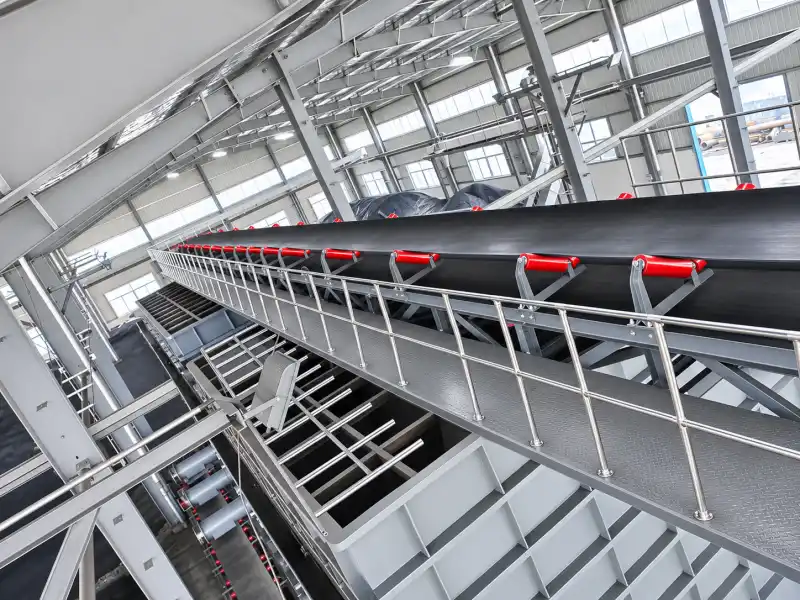
2. How Different Conveyor Belts Are Driven and Supported
The driving method changes the belt specification.
2.1 Friction-Driven Rubber and Flat Belts
Rubber conveyor belts and many flat PVC/PU belts are driven by friction at a pulley. The belt must be tensioned against the pulley so that the pulley can transmit tangential force without slipping.
Insufficient friction produces visible consequences: the belt slips, the contact area heats, the cover glazes or wears faster, and the belt may stop under load. Excessive tension increases the load on the belt, pulley bearings and joints. The required tension therefore comes from the drive condition and load, with a suitable safety margin.
On a conventional bulk conveyor without a belt-turnover device, the material rests on the carrying face during transport. The non-carrying face usually contacts carrying idlers and pulleys. After discharge, the carrying face becomes the downward-facing side on the return run and may contact return idlers. Material that remains on that side can transfer to the return idlers. Carryback is material that fails to discharge at the intended point and accumulates along the return path.
For this reason, “pulley cover” and “return-side surface” describe positions under specified operating conditions. They can refer to different belt faces when a turnover device is installed or the belt is routed differently.
2.2 Positively Driven Modular Belts
Modular plastic belts are normally driven by sprockets. Sprocket teeth engage the underside of the modules or the rod spaces, so the belt receives drive force through positive engagement. The drive specification therefore includes module pitch, sprocket series, number and spacing, shaft arrangement, belt width and load.
Positive engagement reduces reliance on belt-to-pulley friction. The specification must still match the module pitch, sprocket series, number and spacing of sprockets, belt width, load and shaft stiffness. Incorrect engagement can cause jumping, tooth wear, module cracking or uneven belt speed.
2.3 Metal and Other Belt Designs
Metal belts may use chain edges, positive links or another manufacturer-specific drive arrangement. The exact belt design determines how drive force enters the structure. Confirm the rated drive interface and joint design with the belt manufacturer before comparing a metal-belt offer with a rubber or modular belt.
3. How Conveyor Belt Structures Carry Load
The term “carcass” or “reinforcement” applies to belts with a distinct strength layer. Rubber belts normally have it. Reinforced PVC/PU belts also have a reinforcing layer. Monolithic thermoplastic polyurethane (TPU) belts can use one elastomer layer without fabric reinforcement or layered construction. Metal and modular belts use other load-bearing structures.
3.1 Structural Types and Their Contact Surfaces
Belt construction | Applicable belt type | Load-bearing structure | Carrying and contact surfaces |
Fabric-reinforced rubber | EP (polyester/polyamide) and NN (nylon/nylon) belts | Woven fabric plies embedded in rubber | Rubber carrying cover and rubber non-carrying cover; conventional routing places the non-carrying face against carrying idlers and pulleys |
Steel-cord rubber | Steel-cord belts | Parallel steel cords embedded in rubber | Rubber carrying cover and rubber non-carrying cover; cord diameter, pitch and cover thickness form part of the specification |
Reinforced thermoplastic | PVC and PU belts with fabric or other reinforcement | Woven or other reinforcing layer plus thermoplastic sheet | Thermoplastic product surface and opposite belt face; cleats, sidewalls or guides can be added |
Monolithic elastomer | Homogeneous TPU elastic belts | The single elastomer sheet carries load; no fabric or layered carcass | Both surfaces are formed from the same sheet or molded grade, subject to the product’s surface pattern |
Metal | Woven wire, rod link, plate link or chain-edge belts | Wires, rods, plates or linked edge chains | Product rests directly on the metal structure; open area and surface finish set product support and drainage |
Modular plastic | Linked plastic modules and hinge rods | Modules distribute load; rods connect rows and transfer load at the hinge line | The upper module face carries product; the underside contains sprocket-engagement geometry |
The carrying-side and non-carrying-side descriptions above assume a conventional belt path without a turnover device. A turnover installation reverses which face is exposed during the return run and should be evaluated separately.
3.2 Verifiable Shouhuo EP Belt Example
Shouhuo’s in-stock provides a traceable example. Its catalogue data identifies an EP construction as polyester warp and nylon weft. For the EP200 carcass row, it lists:
- 20 mm carcass thickness per ply.
- 400 N/mm with two plies, 600 N/mm with three plies, 800 N/mm with four plies, 1,000 N/mm with five plies and 1,200 N/mm with six plies.
- Top-cover range of 1.5-30 mm, bottom-cover range of 0-20 mm and belt width range of 300-5,600 mm for the product range shown in the same table.
For a three-ply EP200 construction, the catalogue therefore lists 600 N/mm as carcass strength. This value identifies a catalogue rating; it does not represent a reported test result for a specific production batch. The final order still needs the actual cover compound, top-cover thickness, bottom-cover thickness, width, edge and joint.
The same product page lists steel, coal mining, building materials, cement and chemical handling among its application areas, with emphasis on rough material and repeated high-load use. Those are supplier application statements, not proof that one construction suits every material in those industries.
4. How Belt Construction Changes Performance
The same width and thickness can conceal different tensile structures, materials and joint designs. Each performance factor has a separate mechanism.
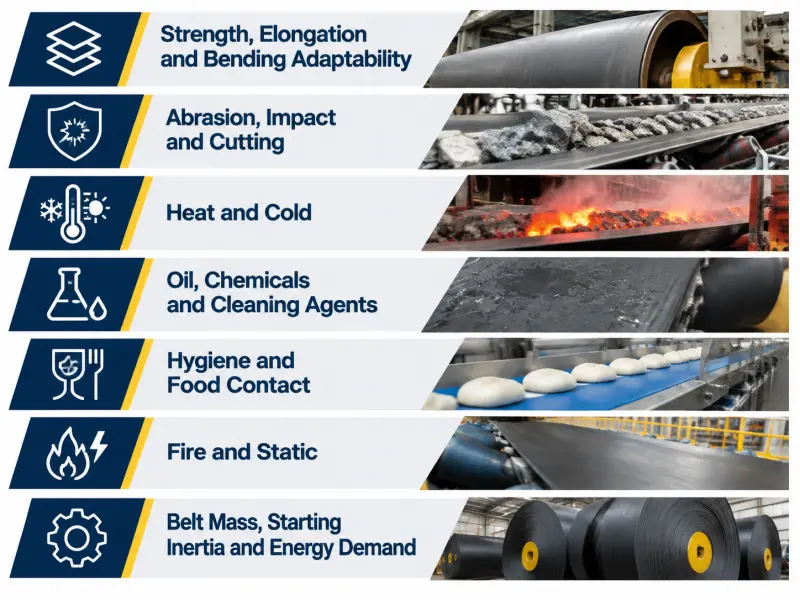
4.1 Strength, Elongation and Bending Adaptability
Fabric-belt strength depends on yarn material, fabric strength and ply count. Steel-cord belt strength depends on cord diameter, cord construction, pitch and tensile grade. The rated strength describes the complete construction and should be compared at the same width and test basis.
Under load, the belt elongates. Elastic elongation changes the working length; permanent elongation remains after unloading and reduces the available adjustment range. Excessive extension increases sag, reduces pulley contact pressure and can cause slip or joint movement.
A belt can meet its tensile rating and still fail in bending. A thick, stiff construction subjected to a small pulley experiences high bending strain. Repeated strain can crack the cover and fatigue fabric plies or steel cords. Section 4.7 addresses the separate effects of belt mass and starting inertia.
4.2 Abrasion, Impact and Cutting
Abrasion removes material through sliding or rolling contact. Hard, angular particles create thinning, polishing or grooves along the product path.
Impact comes from a concentrated force. A large lump can dent or crack the cover and can break the cover-to-carcass bond. Steel-cord belts also need protection because repeated impact can damage the cords or their rubber bond.
Cutting requires a sharp edge that penetrates the surface. A shallow cut reduces cover thickness; a deep cut reaches the carcass or cords, after which moisture, fines and repeated flexing can extend the damage.
An abrasion-resistant compound reduces surface loss. Impact performance instead depends on cover thickness, compound toughness and the reinforcement arrangement. Cut resistance depends on the object’s shape, the cover’s tear behavior and the carcass’s ability to stop crack growth.
4.3 Heat and Cold
Heat ages rubber by hardening the surface and reducing elasticity. Prolonged exposure produces fine surface cracks, deeper cracking and eventually separation between the cover and carcass. The relevant data are the material temperature at contact, the surface temperature of the belt, continuous exposure and peak exposure.
Shouhuo Heat-resistant conveyor belt has three material-temperature bands: T1 at 70-200 C, T2 at 100-400 C and T3 at 100-400 C, with corresponding belt-surface ranges. These are catalogue classifications. The order should identify the actual material temperature, contact time and required test evidence.
Cold stiffens many rubber compounds. A belt may run smoothly on a large pulley and then crack when passed around a smaller pulley or through a thick splice. The lowest start-up temperature, cold-soak time and pulley diameter therefore belong in the specification.
PVC and PU soften at elevated temperature, which lowers their resistance to indentation and can increase stretch under load. Metal belts tolerate higher temperatures in suitable alloys, while repeated heating and cooling applies thermal expansion and fatigue loads at joints and edges.
4.4 Oil, Chemicals and Cleaning Agents
Hydrocarbon oil can swell natural rubber (NR) and styrene-butadiene rubber (SBR), reducing surface hardness and abrasion resistance. NBR, nitrile-butadiene rubber, is used for oil resistance in many compounds. EPDM, ethylene propylene diene monomer rubber, performs well in heat and weather but tends to swell in hydrocarbon oil.
Oil-resistant conveyor belt is a product family for mineral oil, vegetable oil and animal fat and lists -30 C to +70 C as its operating range. That page does not publish an immersion result for every medium. A purchaser should obtain the test medium, temperature, duration and result for the offered grade.
Solvents can extract plasticizer from PVC, leaving it harder and more brittle. Water absorption and chemical attack can also weaken the bond between a thermoplastic cover and its reinforcement. In hydrocarbon service, an oil-resistant surface does not protect the belt if oil reaches the carcass or joint.
PU behavior depends on its formulation. Some polyurethane grades hydrolyze in hot, humid service. Hydrolysis reduces tensile strength and can make the surface split or crumble. The supplier should confirm hydrolysis resistance using the belt’s actual temperature, humidity and contact with water or cleaning chemicals.
4.5 Hygiene and Food Contact
Product residue collects at open fabric edges, rough splices, cleats, sidewalls and damaged belt faces. A smooth, closed PVC/PU surface with sealed edges is easier to clean than an open textile edge with a rough joint. Modular belts need inspection at hinge gaps and rod channels. Metal mesh needs inspection where wires cross and where fine product can lodge.
For rubber articles intended for repeated food contact in the United States, 21 CFR 177.2600 sets out applicable substance and extraction requirements. Food-contact suitability should be confirmed for the exact belt materials and intended conditions, including temperature, direct or indirect contact and cleaning chemicals.
4.6 Fire and Static
Flame resistance limits flame spread under defined test conditions. Antistatic behavior limits charge accumulation. These are separate properties and require separate evidence.
A flame-resistance result does not establish antistatic performance. The anti-static surface also needs an effective discharge path in the installed belt system. In U.S. underground coal mining, 30 CFR 75.1108 requires approved flame-resistant conveyor belts. Other industries and countries require evidence under their own regulations and standards.
4.7 Belt Mass, Starting Inertia and Energy Demand
Belt mass is the total mass of the closed belt loop. A heavier belt increases the inertia that the drive must accelerate during each start. This increases starting torque demand, energy use and the load transmitted through the belt and splice.
The mechanical effect is most visible on wide, thick or heavily covered belts and on systems with frequent starts. It also affects equipment that supports the belt and the operator who handles or replaces it. A lighter belt can reduce these loads if it still meets tensile, impact, temperature and wear requirements.
5. Common Conveyor Belt Forms
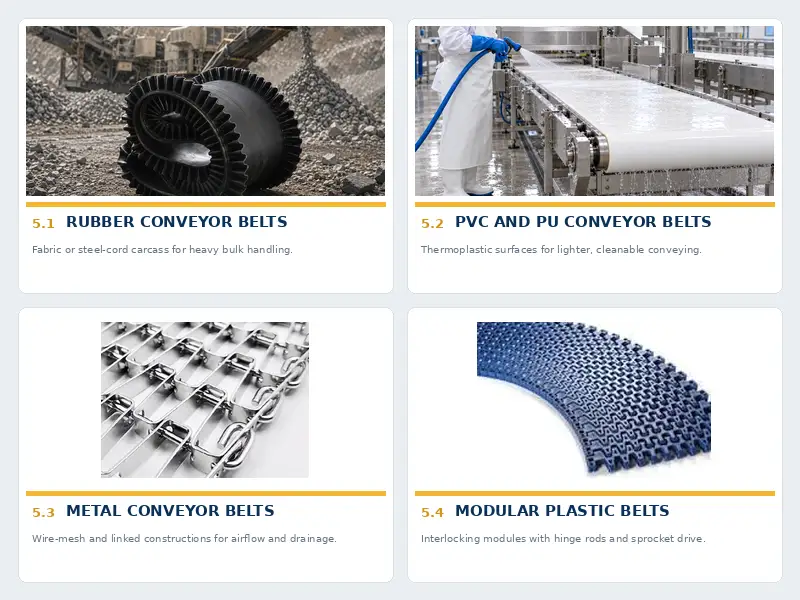
5.1 Rubber Conveyor Belts
Rubber belts use fabric or steel-cord reinforcement with rubber covers. They suit heavy bulk material because the carcass can provide high tensile capacity and the cover compound can address abrasion, heat, oil or flame exposure. Their practical limits include minimum pulley diameter, edge wear and splice requirements; section 4.7 addresses belt mass and starting energy.
5.2 PVC and PU Conveyor Belts
Reinforced PVC/PU belts use a thermoplastic surface with a textile or other reinforcing layer. They suit lighter conveying, smaller pulleys, food handling, packaging and material transfer where flexibility and cleanability matter. The product grade determines temperature range, oil resistance, food-contact suitability and cleaning compatibility.
5.3 Metal Conveyor Belts
Metal belts use wire mesh, rod links, plate links or chain edges. Their open structures support drainage and airflow, and their construction can tolerate hot, heavy or sharp products in suitable alloys. Noise, corrosion and product lodging at wire intersections require review; section 4.7 covers the effects of belt mass and starting inertia.
5.4 Modular Plastic Conveyor Belts
Modular belts use linked modules and hinge rods, with positive sprocket drive. Open modules drain liquid and allow airflow; closed modules support small products. The module design supports curved, straight and accumulation layouts, and attached flights or sideguards can control product movement. Module material, rod material, pitch and sprocket compatibility determine the operating limits.
6. Where Conveyor Belts Are Used
Application | Belt construction | Practical requirement |
Mining and quarrying | Fabric or steel-cord rubber belts | Carry abrasive rock and ore under impact, tension and edge wear |
Cement and building materials | Abrasion- or heat-resistant rubber belts | Carry clinker, limestone and sand at high wear and heat exposure |
Steel and metallurgy | Heat-resistant rubber or metal belts | Move hot sinter, coke, slag or metal components |
Power generation | Flame- or heat-resistant rubber belts | Carry coal, ash and biomass under fire or temperature requirements |
Food processing | PVC/PU, white rubber or modular plastic belts | Provide cleanable product surfaces with suitable contact evidence |
Packaging and logistics | PVC/PU or modular plastic belts | Move cartons, packages or small parts through compact, curved or accumulation layouts |
Ports and bulk terminals | High-strength rubber belts | Carry large bulk volumes over long routes with controlled stretch |
Waste and recycling | Impact-resistant rubber or heavy modular belts | Tolerate mixed material, sharp objects and variable loading |
7. Conclusion
A conveyor belt is a continuous flexible carrying surface whose construction must match its drive method, load, temperature, cleaning and product route. Rubber, PVC/PU, metal, monolithic TPU and modular designs carry load through different structures and require product-specific technical evidence.
8. Frequently Asked Questions
8.1 How should a buyer set top-cover and pulley-cover thickness?
Start with the loading method and wear path, then confirm both cover faces on the same datasheet. The top cover should reflect impact energy, particle shape and sliding abrasion. A thicker impact cover can absorb concentrated impact, but it also adds belt mass and bending strain. The pulley cover needs enough material for pulley and idler contact, while the finished belt must still meet the specified minimum pulley diameter. Ask the supplier to state the compound grade, top and bottom cover thickness, total thickness, belt mass and minimum pulley diameter for the offered construction.
8.2 When does a belt-turnover route change the cover specification?
Under conventional routing, the carrying face becomes the return-side face after discharge. A turnover device can return the carrying cover to the top before it enters the return idlers. This changes which face contacts return-side components and may reduce transfer of carryback. The order drawing should therefore show the route and name the faces that contact carrying idlers, return idlers and drive pulleys. Do not rely only on “top” and “bottom” when a turnover device is included.
8.3 What evidence should accompany a flame-resistant and antistatic belt offer?
Request separate evidence for flame resistance and antistatic behavior. The flame report should identify the required standard, test condition and permitted result for the offered compound and construction. The antistatic evidence should identify the resistance or charge test, its limit and the tested product. Check that neither report covers only a generic material family or another construction. During acceptance, also verify that the installed belt system provides the intended discharge path; a flame-resistance result alone does not establish antistatic performance.
8.4 What does an EP200 catalogue rating leave to the purchase order?
EP200 may identify a strength class, but the order still needs the rating’s width and test basis, ply count, fabric construction, cover compound, top and bottom cover thickness, edge type, belt width, length and joint method. For a multi-ply belt, confirm whether the quoted N/mm value applies to the carcass, finished belt or a reference width. Match the offered construction and batch documentation to those fields. A catalogue strength value does not by itself demonstrate the performance of a specific production lot.
8.5 Which operating conditions should trigger a review of metal or modular belts?
Review the material path before defaulting to rubber. High-impact lump loading and long high-tension routes commonly call for a rubber belt with an appropriate carcass and cover. Frequent washdown, small pulleys, open drainage or product accumulation may justify PVC/PU or modular construction. Metal construction may need separate review for high temperature, sharp product or open support. Include belt speed, corrosion exposure, maintenance access and joint requirements in the review, because no material family fits every duty.