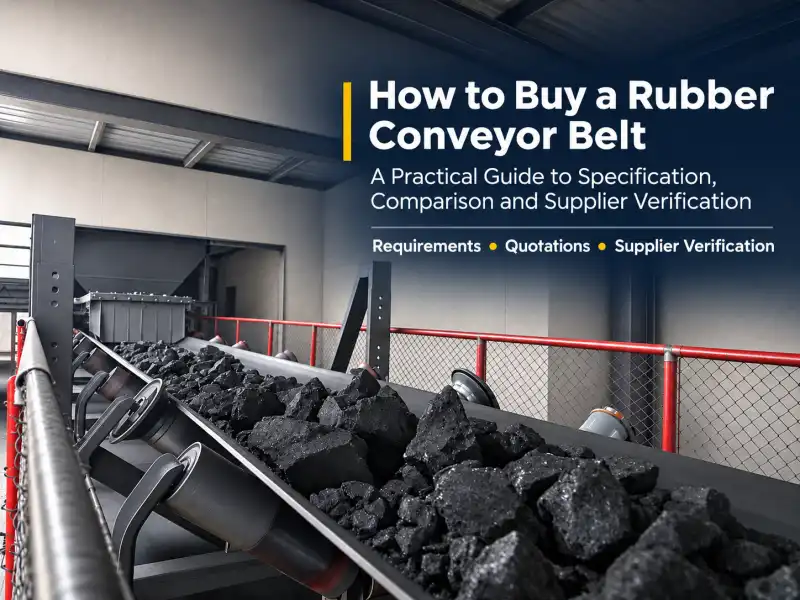
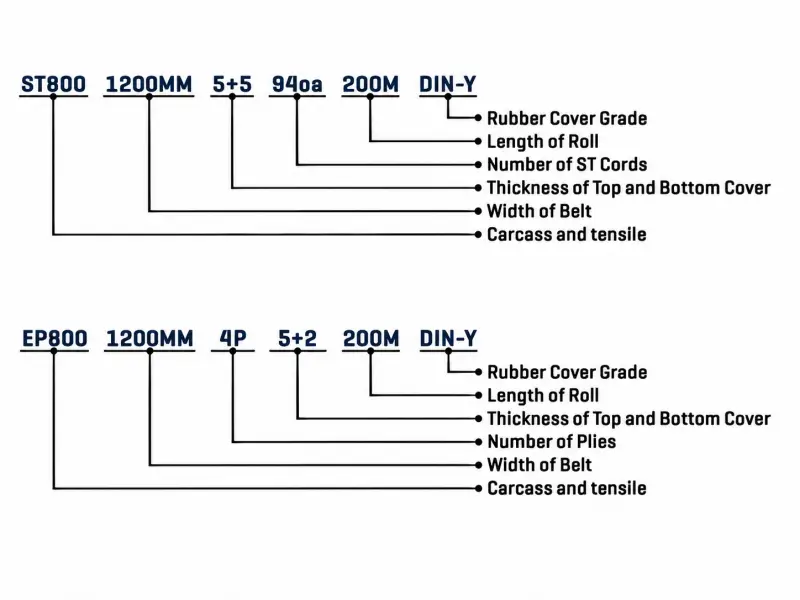
To complete a conveyor belt purchase, collect the material, normal and peak TPH, belt width, speed, length basis, carcass, top and bottom cover thickness, edge, and required joint. This guide explains how to specify these fields, compare quotations, and keep a reliable replacement record.
1. How to Define Your Conveyor Belt Purchase Requirements
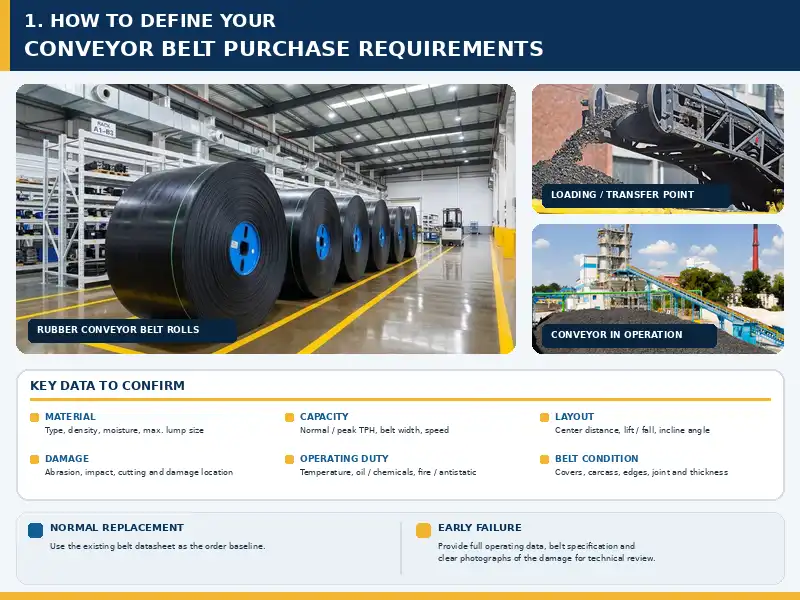
Section 1 covers normal replacement and premature-failure recommendations. For normal replacement, use the existing datasheet. When the belt can no longer remain in service and a new supplier must recommend a replacement, provide the material, capacity, dimensions, operating conditions, and damage data in Sections 1.1 to 1.5.
1.1 Identify the Material and Maximum Lump Size
Record the material name, bulk density, moisture condition, particle-size range, maximum lump size, fines content, and stickiness. These properties determine the required load depth, troughability, impact protection, and cover resistance.
Maximum lump size is a useful quotation field because lump mass and drop height at the loading point influence impact severity. A dense lump can cause more local stress than a larger light lump. The same material record should cover normal variations and occasional oversized material.
1.2 Record TPH, Belt Width, Speed, and Center Distance
Provide normal TPH and peak TPH for the belt being purchased. State belt width, belt speed, center distance, lift or fall, and incline or decline angle. These values establish the material load, belt capacity, and the rated strength needed for the order.
TPH, width, and speed should be quoted together. A belt width that carries the required load at one speed may run with a deeper or less stable material bed at another. The belt’s rated tensile strength and safety factor should appear in the supplier datasheet for the selected construction.
For a replacement order, supply the existing belt specification and the installed belt length. The supplier can use that record to confirm the replacement construction.
1.3 Distinguish Wear, Impact, and Cutting
Normal abrasion reduces cover thickness along the material path through sliding and rolling contact. Correctly installed rubber skirts and cleaners produce controlled wear when their clearance and pressure suit the belt. The useful quotation data are the annual or replacement-cycle cover loss and the remaining top-cover thickness.
High-drop loading with large lumps concentrates impact energy and can dent, crack, or loosen the cover.
Material trapped or protruding at the loading point can cut the cover, and sharp oversized debris can cause local damage. Record the drop height, maximum lump, and damage location so these conditions appear in the specification.
A thicker top cover adds wear allowance and impact tolerance. It also increases belt mass, pulley bending load, and conveyor power demand, which raises purchase and operating costs. The right thickness balances service interval against energy use.
1.4 Record Temperature and Chemical Exposure
Record ambient temperature and the material temperature at the loading point, where hot material first contacts the belt. For heat-resistant service, the material temperature at first contact and the continuous operating temperature are the primary selection inputs.
For oil and chemical exposure, record the medium, concentration, contact temperature, and contact pattern. Common examples include mineral oil, grease, acid, alkali, solvent, salt water, steam, and process wash water. The cover compound and datasheet should correspond to those conditions.
Fire-resistant (flame-retardant) belts are used in underground mining, tunnels, coal handling, enclosed material-transfer areas, and facilities handling combustible dust.
In hazardous locations, check whether you also need antistatic properties because static accumulation can create an ignition source. For coal and other combustible bulk, specify fire-resistant and antistatic properties together where the project or safety rules require them.
Specify a fire-resistant oil-resistant cover when oil or grease contact occurs in the same area requiring fire resistance. The supplier datasheet should list the fire-resistant and antistatic properties, including the test method and result.
1.5 Review the Current Belt Condition
Read the belt label and compare the current condition with the original specification. Record top-cover and bottom-cover thickness, width, carcass construction, edge condition, joint type, and the main damage locations. This record shows whether the previous specification delivered normal service or should be changed.
Normal service wear produces gradual thickness loss along the material path. Early damage commonly appears as local deep wear, cover separation, cracking, edge exposure, ply or cord exposure, or repeated joint opening. Use the position and form of that damage to decide which specification field needs review.
1.6 Choose the Replacement Data Path
A normal replacement uses the existing belt datasheet as the order baseline. Provide the original width, length, carcass and strength, top and bottom cover grade and thickness, total thickness, edge type, and joint or finished-belt requirement. The supplier can match the record and confirm current availability.
An early failure requires a technical review of the replacement construction.
Provide the full existing belt specification, actual width, used top-cover and bottom-cover thickness, material properties, TPH, speed, center distance, angle, temperature, oil or chemical exposure, joint type, and clear photographs of the damage. Section 7.2 lists the operating data that helps the supplier recommend a revised construction.
2. Which Rubber Conveyor Belt Fits Your Application
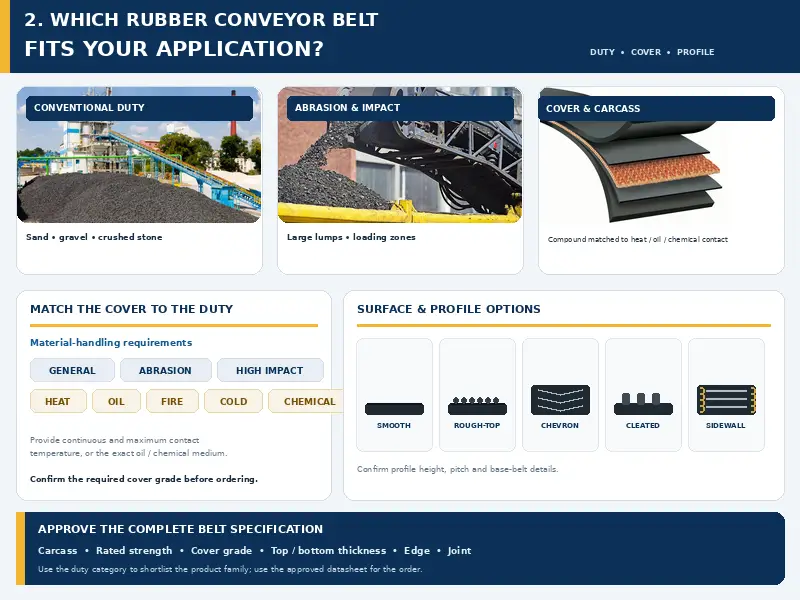
Rubber conveyor belts are classified by material-handling duty and carcass construction. Use the duty name to locate the product family, then confirm the belt’s carcass, covers, dimensions, edge, and joint in the quotation.
2.1 Conventional Material Handling
A conventional rubber conveyor belt suits dry or slightly moist bulk material with ordinary abrasion and moderate impact. Typical uses include sand, gravel, crushed stone, grain, fertilizer, and general bulk handling.
The approved datasheet should still list the carcass, rated strength, cover grade, top and bottom cover thickness, and edge type. Those fields define the belt for purchase and future replacement.
2.2 High-Abrasion and High-Impact Duty
Select a wear-resistant cover when cover thickness decreases too quickly along the material path. Select a high-impact construction when the loading point produces dents, cover cracks, or separation under large lumps.
Mines, quarries, cement plants, steel works, ports, and waste facilities often need both properties. Record the damage pattern and loading height so the supplier can decide whether to change the top-cover thickness, cover grade, impact support, or belt rated strength.
2.3 Heat, Oil, Fire, Cold, and Chemical Resistance
A heat-resistant belt suits material that reaches the loading point above the operating temperature of a standard cover. Provide the material’s continuous temperature and maximum temperature at first contact.
An oil-resistant belt suits mineral oil, grease, or hydrocarbon contact. A chemical-resistant belt requires the exact medium because acid, alkali, solvent, and process water can require different compounds. Cold-resistant service needs the lowest belt start-up temperature and running temperature.
Use the relevant product pages as starting points, then approve the final datasheet:
- Heat-resistant belt: high-temperature conveyor belt
- Wear-resistant belt: wear-resistant conveyor belt
- Fire-resistant belt: fire-resistant conveyor belt
2.4 Smooth, Patterned, Chevron, Cleated, and Sidewall Belts
Smooth belts suit horizontal and gently inclined material flow. Rough-top belts improve grip for selected light-duty or packaged materials. Chevron belts help retain loose bulk material on an incline. Each option still uses a defined base belt and carcass.
Cleated and sidewall belts include profile height, pitch, and base-belt requirements in the ordering data. Provide a cross-section drawing and confirm the profile, base belt, edge, and joint. These belts are specified as complete belt assemblies.
3. How Cover Rubber Grade and Thickness Affect Performance
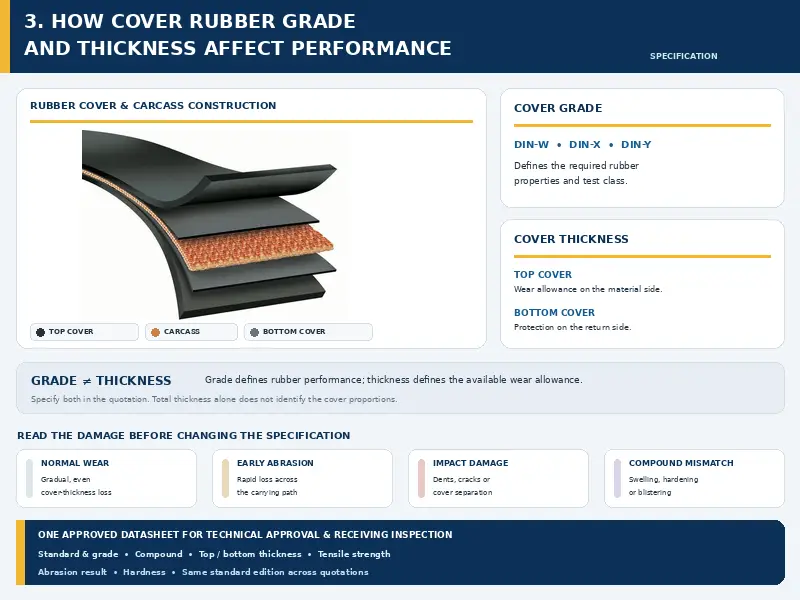
The top cover contacts the material stream. The bottom cover contacts return idlers and pulleys. The quotation normally lists top-cover thickness, bottom-cover thickness, and total thickness. The top cover is usually thicker because it carries the main material wear.
3.1 Specify Compound, Grade, and Thickness
The rubber compound identifies the base elastomer or blend. The cover grade identifies a standard class such as DIN-W, DIN-X, or DIN-Y. The datasheet should list cover tensile strength, abrasion value, hardness, and top and bottom cover thickness.
The cover grade and cover thickness perform different purchasing functions. The grade defines the required rubber properties, while thickness sets the wear allowance. The quotation should show both so the buyer can compare a complete construction.
3.2 Set Top and Bottom Cover Thickness
Top-cover thickness follows the wear rate, impact severity, loading height, inspection interval, and expected replacement cycle. A thicker top cover provides more rubber before the carcass becomes exposed.
Bottom-cover thickness follows return-side contact, buildup, and edge protection. The quotation should list top cover, bottom cover, and total belt thickness because the same total thickness can use different cover proportions.
3.3 Verify the Cover with One Approved Datasheet
DIN and ISO standards define fixed grades, test ranges, methods, and acceptance values. A DIN-X cover uses the abrasion, tensile strength, and other requirements defined by its standard class. Comparison becomes straightforward when each quotation uses the same standard edition and grade.
A single complete datasheet should identify the standard and grade, rubber compound, top-cover thickness, bottom-cover thickness, tensile strength, abrasion result, and hardness. Use that datasheet for technical approval and receive inspection. Additional commentary adds no value when these values already match the fixed standard.
3.4 Separate Normal Wear from Early Cover Damage
Condition | Typical observation | Purchasing response |
Normal wear | Gradual cover-thickness loss along the material path; damage develops over the expected service interval | Repeat the approved specification and maintain thickness inspection |
High-abrasion early wear | Faster thickness loss across a broad carrying path before the expected interval | Review top-cover grade, top-cover thickness, material abrasiveness, and throughput |
Impact damage | Dents, cracking, or cover separation under a loading point | Review maximum lump, drop height, impact support, and top-cover thickness |
Cover mismatch | Swelling, hardening, cracking, blistering, or separation under oil, heat, or chemical exposure | Match the compound and grade to the measured exposure and datasheet |
Mechanical damage | Local cuts or gouges from oversized or trapped material at the loading point | Correct the material path and confirm whether tear or impact resistance needs review |
Normal wear supports repeat purchase. Local or rapid damage justifies a specification review. This distinction prevents a normal wear allowance from being treated like a belt defect.
3.5 Avoid Excess Cover Thickness
A cover that is thicker than the duty requires adds purchase cost, belt mass, pulley bending load, and conveyor power demand. Compare the expected wear allowance with the annual measured cover loss, then choose the lowest thickness that covers the planned service interval and inspection margin.
4. How Textile and Steel Cord Construction Carry the Belt Load
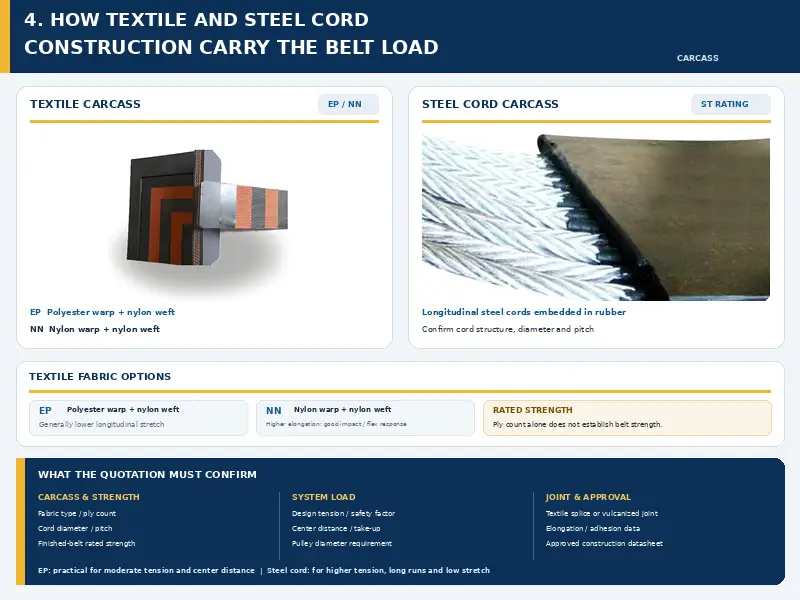
Every belt quotation identifies the carcass type, tensile class, and construction. These fields determine the belt’s rated strength, elongation behavior, splice type, and suitability for the required belt width.
4.1 Textile Conveyor Belt Construction
EP fabric uses polyester warp yarns and nylon weft yarns. It generally provides low longitudinal stretch and useful transverse flexibility. NN fabric uses nylon in both directions and provides good impact and flex response, with higher elongation that may require more take-up travel.
Textile belt data should include fabric type, ply count, fabric strength, total rated strength, width, covers, and edge. Review EP conveyor belts and NN conveyor belts by their approved construction.
4.2 Ply Count and Rated Strength
Two-ply and three-ply belts can reach different rated strengths when they use different fabric strengths. The datasheet should state the rated strength for the finished belt width and construction.
Use rated belt strength, belt width, design tension, safety factor, and the applicable product standard when checking a quotation. A higher ply count alone does not establish a stronger order.
4.3 Steel Cord Conveyor Belt Construction
A steel cord belt uses longitudinal steel cords embedded in rubber. The quotation should include cord structure or diameter, cord pitch, cord tensile strength, belt rated strength, width, covers, edge, and vulcanized joint.
Steel cord construction suits high-tension and long-center-distance duties with low longitudinal stretch. The approved order should include the pulley diameter requirement and cord-rubber adhesion data. Review the steel cord conveyor belt product range, then approve the project datasheet.
4.4 Choose EP or Steel Cord
Operating state | Recommended direction | Reason and quotation check |
Required rated strength is available in standard EP classes; center distance is moderate; pulleys accept a textile carcass | Choose EP | Lower belt mass and cost, low longitudinal stretch, and standard textile joint options |
Required strength is near the top of textile classes; take-up travel is limited; the load remains stable | Strongly consider EP | Confirm the rated strength, safety factor, elongation, and minimum pulley diameter |
Required rated strength exceeds standard textile classes; center distance is long; low stretch is important | Choose steel cord | Confirm belt strength, cord pitch, pulley diameters, adhesion, and vulcanized joint capability |
Wide belt under high tension, long incline, and high continuous load | Choose steel cord | Lower stretch reduces take-up demand and maintains tension control |
Frequent impact with sufficient take-up and lower rated tension | Choose NN or an impact-rated EP construction | Confirm impact support, elongation, pulley flex, and joint |
EP is the practical textile choice for moderate tension, good flexibility, low stretch, and economical replacement. Steel cord is the practical choice when the required tension, center distance, and low-stretch requirement exceed the approved EP range.
5. How to Specify Dimensions and Edge Construction
A belt quotation uses width, length, thickness, carcass, covers, edge, and finished-belt requirement. Overall conveyor drawings rarely supply the detailed belt data needed to compare suppliers.
5.1 Belt Width and Length
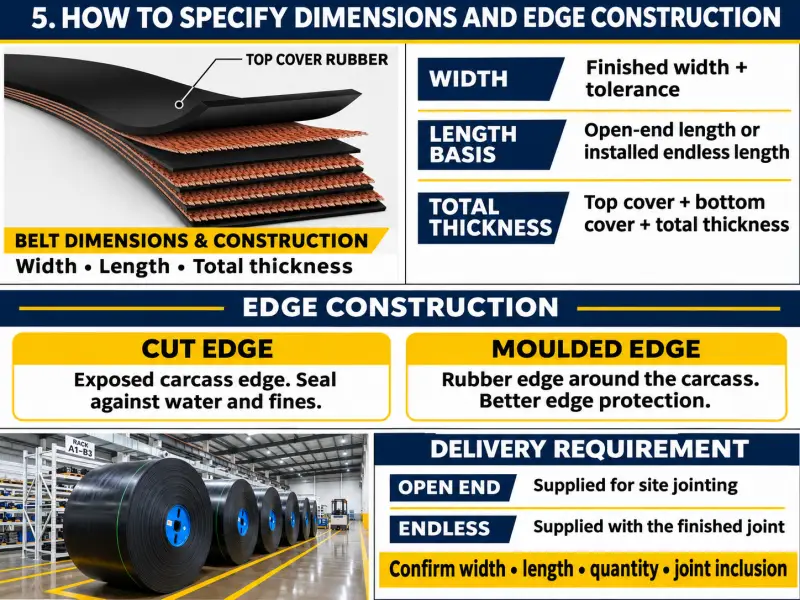
State the finished belt width and the required length basis. Use open-end length when the buyer will make the joint, or installed endless length when the supplier will deliver a finished belt.
For replacement, record the old belt specification and measure the installed belt where possible. A stretched belt may show a longer installed length, so the old datasheet remains the primary construction reference.
5.2 Total Thickness and Cover Thickness
List total thickness, top-cover thickness, and bottom-cover thickness. Add the carcass construction and finished width. State the thickness tolerance and measuring method.
The top-cover reading should be taken over the material-carrying area. Compare the delivered belt with the approved datasheet at the agreed inspection points.
5.3 Cut Edge and Moulded Edge
Cut-edge belts provide good flexibility for many textile constructions. The edge should be sealed and protected against water and fine-particle ingress. Moulded-edge belts form a rubber edge around the carcass and can provide stronger edge protection on heavily loaded or exposed belts.
Choose the edge for the actual wet, impact, side-load, and pulley conditions. Request the edge cross-section when the quotation uses general wording such as reinforced edge.
5.4 Open-End and Endless Delivery
An open-end belt is supplied in the required length for jointing on site. A finished endless belt is joined to the required installed length before delivery. State the belt width, length, quantity, and whether the quotation includes the finished joint.
Dimension field | Quotation detail |
Width | Finished belt width and tolerance |
Length | Open-end length or installed endless length |
Total thickness | Nominal total thickness and tolerance |
Top cover | Grade and thickness |
Bottom cover | Grade and thickness |
Carcass | EP, NN, steel cord, ply count or cord construction, and rated strength |
Edge | Cut edge or moulded edge |
Finished belt | Open end or endless, with the required joint |
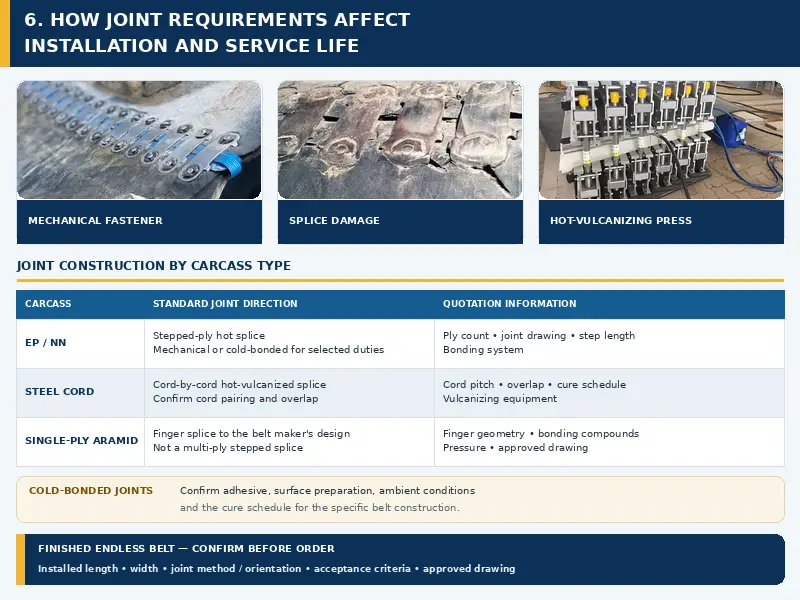
6. How Joint Requirements Affect Installation and Service Life
The joint method follows the carcass. Open-end belt orders usually need the carcass, width, cover thickness, and open length. Include the joint specification when the supplier will deliver a finished endless belt or pre-jointed belt.
6.1 Mechanical Joints
Mechanical joints use fasteners to connect belt ends. They suit selected textile belts where quick installation or temporary service is useful. The quotation should confirm the fastener size, belt thickness range, pulley clearance, and cleaner clearance.
6.2 Cold-Bonded Joints
Cold-bonded joints use an adhesive system and prepared belt ends. They suit textile belts where the approved adhesive, surface preparation, ambient conditions, and cure schedule can be controlled. The joint supplier should provide a procedure for the specific belt.
6.3 Joint Construction by Carcass Type
Textile EP and NN belts use a stepped ply joint. The technician removes cover rubber and builds overlapping fabric steps, then joins the steps with approved bonding compounds under heat and pressure. The step length, ply sequence, pressure, temperature, and cure time come from the belt manufacturer’s joint drawing.
Steel cord belts use a cord-by-cord vulcanized joint. Each steel cord is aligned and tensioned according to the joint pattern, then bonded under controlled heat and pressure. The joint drawing defines the overlap, cord pairing, cover restoration, pressure, and cure schedule. Qualified equipment and a trained splicing crew are essential.
Aramid conveyor belts need special attention. Most aramid belts have one fabric ply, and a finger splice is normally the correct method.
A conventional multi-step textile splice does not apply because there are no separate fabric plies to step. Obtain the aramid belt manufacturer’s drawing and use the specified finger geometry and bonding materials.
Carcass | Standard joint direction | Quotation information |
EP or NN textile | Stepped fabric-ply splice; mechanical or cold-bonded types can suit selected duties | Ply count, joint drawing, joint length, and bonding system |
Steel cord | Cord-by-cord hot-vulcanized splice | Cord pitch, joint drawing, overlap, equipment, and cure schedule |
Single-ply aramid | Finger splice | Finger dimensions, compounds, pressure, and joint drawing |
6.4 Specify a Finished Joint Accurately
For a finished endless belt, state the installed length, width, joint method, joint orientation, and acceptance requirements. Use the supplier’s approved joint drawing as part of the order. The delivered belt should match the approved joint construction.
7. What to Include in Your Conveyor Belt Purchase RFQ
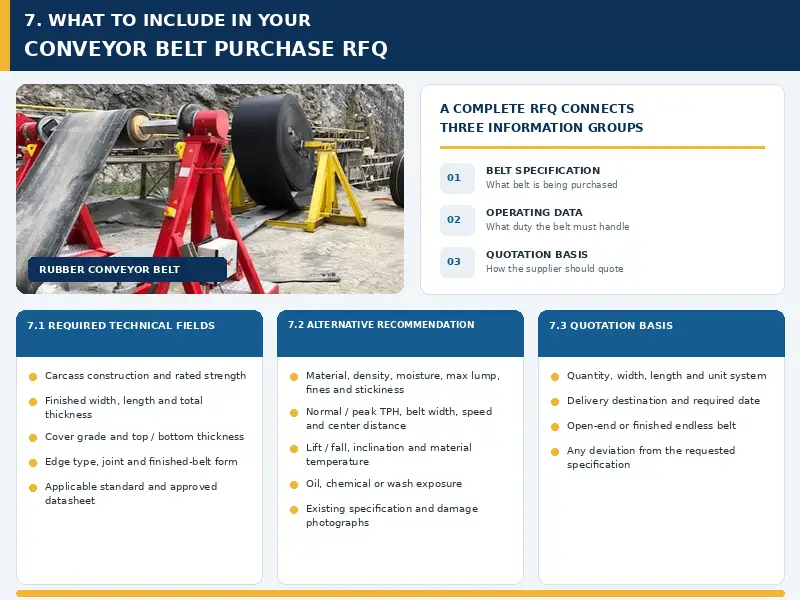
The RFQ should identify the belt specification, quantity, and quotation basis in one clear document. Use the form below to collect the required fields.
7.1 Recommended Belt Data for an Alternative Recommendation
When you need a different construction, provide the existing datasheet and operating data:
- Material name, bulk density, moisture, maximum lump size, fines, and stickiness.
- Normal TPH, peak TPH, belt width, belt speed, center distance, lift or fall, and angle.
- Material temperature at the loading point and ambient temperature.
- Oil, grease, chemical, salt water, steam, or wash exposure.
- Existing carcass, rated strength, cover grade, top and bottom cover thickness, edge, and joint.
- Photographs and measurements of wear, impact, cutting, or joint damage.
These details let the supplier identify whether the replacement should repeat the current specification or change the carcass, cover, or thickness.
7.2 Quotation Basis
State the quantity, requested belt length, width, unit system, destination, required delivery date, and whether the belt is open-end or endless. Ask the supplier to quote the exact construction and state any deviation from the requested fields.
8. How to Compare Rubber Conveyor Belt Quotations
Compare quotations on the belt construction and the quoted quantity. Convert every offer to the same width, length basis, cover thickness, and carcass before comparing price.
8.1 Check Technical Equivalence
Check belt width, length, carcass type, ply count or cord construction, rated strength, cover compound and grade, top-cover thickness, bottom-cover thickness, total thickness, edge, and joint for a finished belt. The datasheet should support each value.
A quotation that uses a thinner cover or lower carcass class can carry a lower price while describing a different belt. Record both constructions in the comparison.
8.2 Compare Price per Meter and Price per Kilogram
Rubber belts are commonly quoted by meter or by weight. Compare the total quote for the same finished width, length, and construction. Check whether the stated meter price uses nominal or minimum thickness and whether the total length includes the required joint allowance.
Use both unit prices as checks. Price per meter shows the linear belt cost clearly. Price per kilogram helps compare belts with different thicknesses when the construction is known. Neither price replaces the finished-belt specification.
8.3 Compare Service Cost
A lower-priced belt can increase total cost when it wears faster, produces more carryback, or requires earlier replacement. Compare expected wear allowance, top-cover grade, bottom-cover protection, rated strength, and energy demand from belt mass.
The most economical quotation provides the required strength and cover life with controlled belt mass and power demand. Use the measured cover-loss rate from the previous belt to compare realistic replacement intervals.
9. How to Verify a Rubber Conveyor Belt Manufacturer
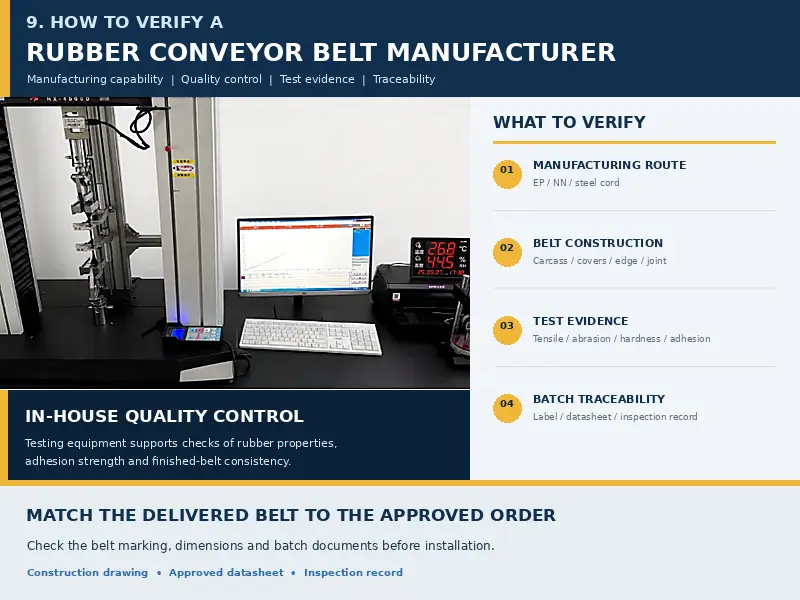
Supplier verification should confirm that the factory can produce the quoted belt construction and that the delivered belt matches its approved datasheet.
9.1 Review Manufacturing Capability
Confirm the factory’s product range and its production route for EP, NN, steel cord, and specialized cover compounds. Ask for an approved construction drawing for the quoted belt.
The drawing should identify the carcass, ply or cord construction, rated strength, cover grade, top and bottom cover thickness, edge, width, and joint.
9.2 Verify Quality Control and Batch Consistency
Agree on inspection points for cover thickness, width, length, edge condition, appearance, and belt identification. For steel cord belts, include cord construction, adhesion, and joint preparation.
Connect the delivered belt label to its batch, datasheet, and inspection record. This allows the buyer to verify the actual order after delivery.
9.3 Review the Technical Datasheet and Test Evidence
The datasheet should use the same standard grade and construction as the approved order. Confirm tensile strength, cover tensile strength, cover abrasion, hardness, adhesion where applicable, and fire-resistant or antistatic properties where required.
Belt property | Datasheet evidence |
Textile strength | Fabric type, ply count, fabric strength, rated belt strength, and applicable test method |
Steel cord strength | Cord structure, pitch, cord strength, rated belt strength, and adhesion |
Cover grade | DIN or ISO grade and fixed acceptance values |
Cover thickness | Top cover, bottom cover, and total thickness with tolerance |
Fire and antistatic | Test method, result, and applicable class |
9.4 Check Belt Identification
The delivered belt should carry the product code, construction, width, length, batch reference, and any handling direction. Compare the label and delivered dimensions with the approved datasheet before installation.
9.5 What You Can Verify About Shouhuo
Shanghai Shouhuo Rubber & Plastic Co., Ltd. has manufactured rubber and plastic products since 2008. Our factory covers over 40,000 square meters and can produce approximately 15 million square meters of conveyor belts per year.
The product range includes rubber conveyor belts, PVC/PU conveyor belts, transmission belts, and industrial rubber sheets. Our cover grades are compliant with DIN-W, DIN-X, and DIN-Y systems for the relevant product ranges.
For a conveyor belt purchase, ask us for the construction drawing, approved datasheet, covers, edge, joint, and quotation basis for your order.
10. Conveyor Belt Purchase Checklist Before You Place an Order
Stage | Check |
Material and capacity | Material properties, maximum lump, normal TPH, and peak TPH are recorded |
Dimensions | Finished width, open-end or endless length, and quantity are confirmed |
Carcass | EP, NN, or steel cord construction, tensile class, and rated strength are approved |
Textile data | Ply count and fabric strength are included for EP and NN belts |
Steel cord data | Cord structure, pitch, strength, and joint drawing are included |
Covers | Compound or grade, top-cover thickness, bottom-cover thickness, and total thickness are listed |
Edge and finish | Cut edge or moulded edge and open-end or finished endless delivery are stated |
Joint | Joint method and drawing match the textile, steel cord, or aramid construction |
Datasheet | Standard grade, abrasion, tensile strength, hardness, adhesion, fire resistance, and antistatic data match the order |
Price basis | Width, length, thickness, construction, quantity, and unit price use the same basis |
Identification | Product code, batch, width, length, and construction are approved for delivery inspection |
11.Conclusion
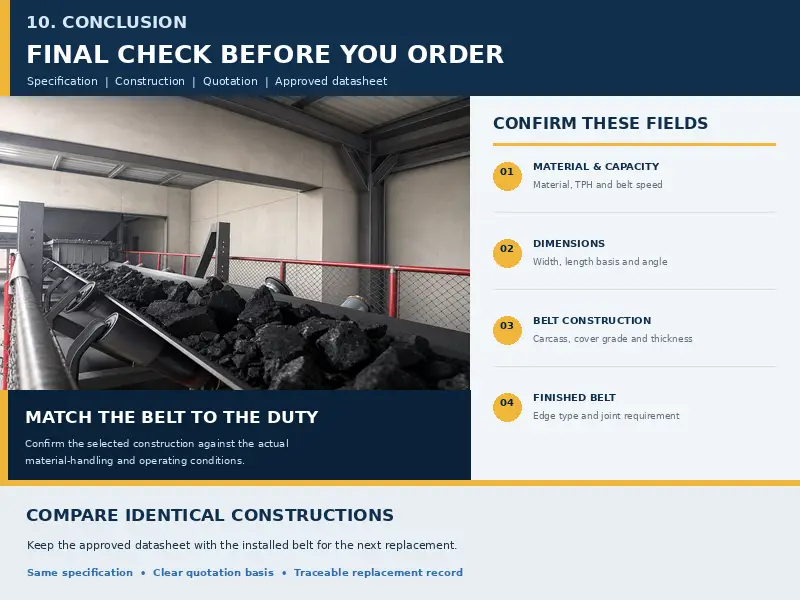
For a conveyor belt purchase, confirm material, TPH, width, speed, length basis, carcass, cover grade, top and bottom cover thickness, edge, and joint. Compare identical constructions and keep the approved datasheet with the installed belt. That record makes the next replacement faster and more reliable.
12.FAQ
12.1 Can a Higher-Abrasion Cover Grade Prevent Belt Cutting?
A higher-abrasion grade improves resistance to gradual surface wear. It does not address sharp oversized material trapped at a loading point.
Cover cutting requires a review of maximum lump size, drop height, loading-point condition, and tear resistance. Correct the material path and confirm the cover compound and impact construction with the belt manufacturer.
12.2 Why Should a Replacement Belt Use the Original Datasheet?
An installed belt can stretch, wear thinner, or lose part of its label. The measured length and thickness then describe the used belt, while the original datasheet defines its carcass, rated strength, cover grade, and purchase construction.
Send both records to the supplier so the replacement matches the intended belt and current installation.
12.3 When Do You Need Fire-Resistant and Antistatic Properties Together?
Specify both in underground mining, tunnels, coal handling, combustible-dust areas, and enclosed transfer systems where static discharge could create an ignition source. Ask the datasheet to show the fire-resistant class, antistatic test method, and measured result. Add oil resistance when grease or fuel also contacts the belt.
12.4 Can an Aramid Conveyor Belt Use a Standard Stepped Textile Splice?
Most aramid belts use a single fabric ply, so a finger splice is the normal method. A stepped splice needs multiple fabric plies. Obtain the aramid manufacturer’s joint drawing and use its finger dimensions, overlap, compounds, pressure, and cure schedule.
12.5 Why Compare Belts by Both Meter and Kilogram?
The meter price shows the linear cost for a stated width and thickness. The kilogram price exposes differences in belt mass when the same width and length use different constructions. Compare both with the finished carcass, cover thicknesses, tolerances, and rated strength before approving the lower offer.