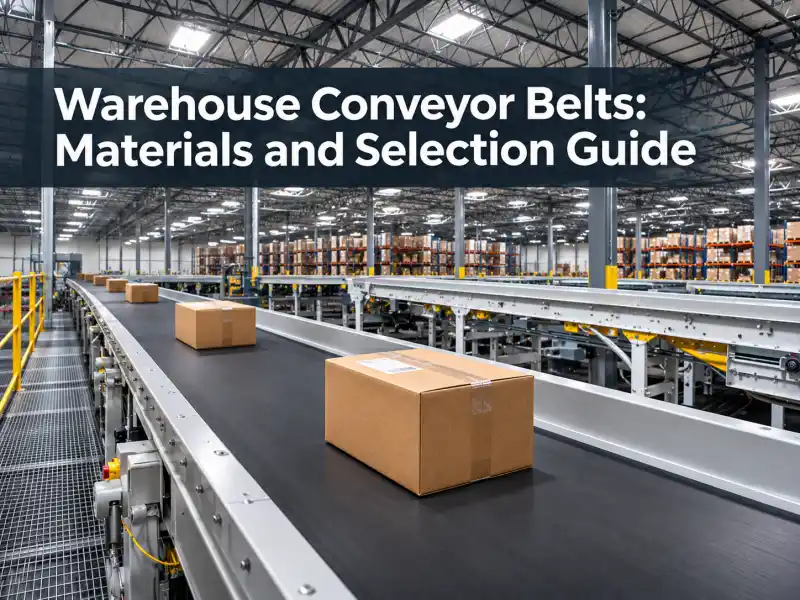
Warehouse conveyor belts move packed goods after production, not raw process material. Grain bags, rice bags, flour bags, feed bags, fertilizer bags, cartons and totes require different belt structures. For grain and bagged agricultural storage, rubber is the first choice. For general industrial and distribution warehouses, PVC or PU is the first choice.
1. What Are Warehouse Conveyor Belts?
A warehouse conveyor belt is a flexible, reinforced belt that carries packed goods between receiving, storage, packing and dispatch areas. It must support the bag or package, withstand repeated loading, keep the goods stable and form a reliable closed loop through the conveyor.
1.1 Packaged Warehouse Duties
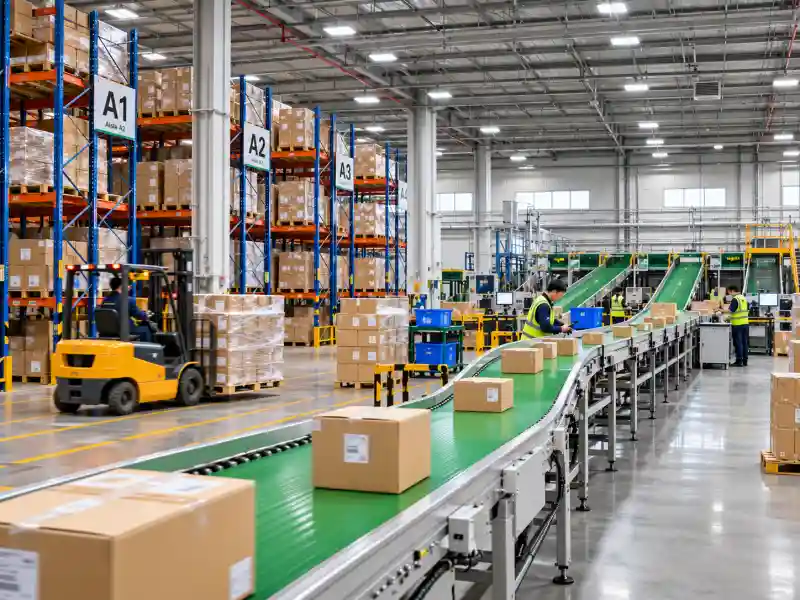
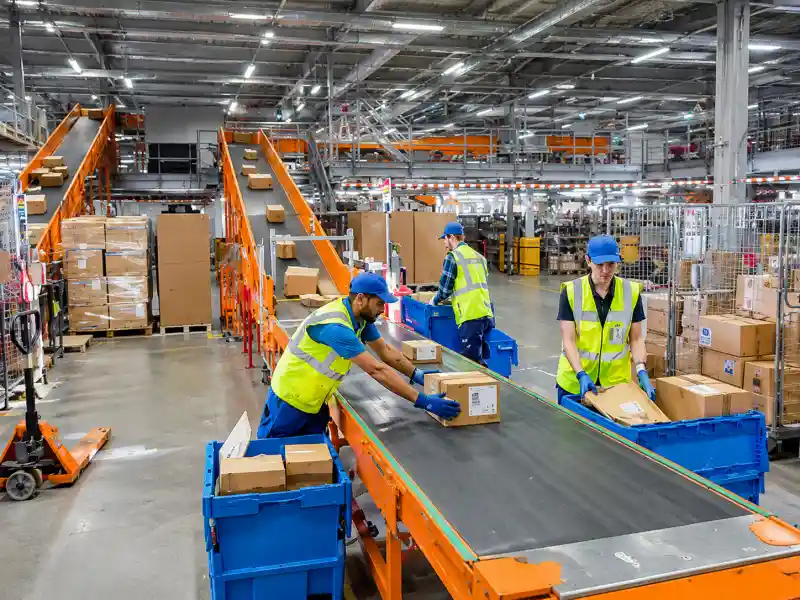
Warehouse handling starts after the product has been packed. A rice mill may move rice bags from the packing area into storage and then to the loading bay. A feed or fertilizer warehouse may move finished bags between storage zones. A distribution center may move cartons, parcel cages or plastic totes between receiving and dispatch.
The belt therefore sees finished packaging rather than raw grain, wet material or process slurry. This changes the main design questions: bag mass, bag condition, impact at transfer, surface grip, package release, line speed and splice reliability.
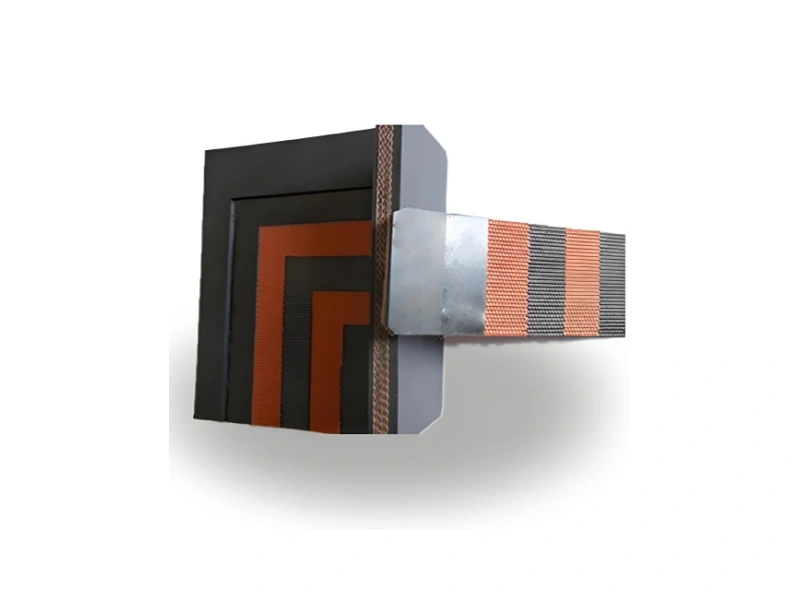
1.2 Basic Belt Construction
Belt element | Function | Selection data |
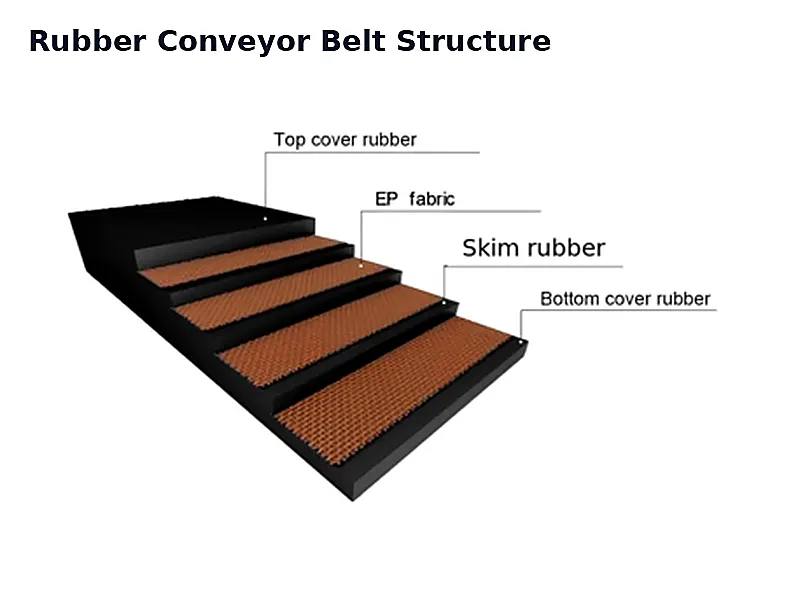
Carcass | Carries tension and stabilizes the belt | Belt family, strength class, ply count or cord structure, elongation |
Top cover | Carries the packed goods and protects the carcass | Compound grade, top-cover thickness and required surface |
Bottom cover | Runs against pulleys, idlers or the slider bed | Bottom-cover thickness, contact pressure and build-up risk |
Edges | Maintains belt width and resists side damage | Edge type, guide clearance and wear history |
Accessories | Provide grip, containment or tracking | Cleat, sidewall, guide and splice geometry |
Figure 1. Typical textile conveyor belt construction with fabric reinforcement, covers and bonded layers.
2. Warehouse and Storage Applications
Our selection rule is straightforward. For grain depots, silos, rice mills, flour or feed warehouses, and agricultural or fertilizer stores, select a rubber conveyor belt first. For general industrial warehouses and distribution centers, select a PVC or PU conveyor belt first.
Warehouse application | Packed goods | First choice | Recommended construction |
Grain depot or silo | Packed grain or seed bags | Rubber | Fabric-carcass rubber belt with a smooth or rough carrying cover |
Rice mill warehouse | Packed rice bags | Rubber | Fabric-carcass rubber belt with reinforced edges |
Flour or feed warehouse | Packed flour or feed bags | Rubber | Rubber belt with a clean-release carrying cover |
Agricultural or fertilizer store | Packed seed or fertilizer bags | Rubber | Rubber belt with an approved compound and reinforced edge |
General industrial warehouse | Boxed or wrapped finished goods | PVC/PU | Fabric-reinforced PVC/PU belt with a smooth surface |
Distribution center | Cartons, parcel cages and totes | PVC/PU | PVC/PU belt with a smooth surface and reliable splice |
2.1 Grain Rice Flour Feed and Fertilizer Warehouses
These warehouses share bagged products, substantial bag weight and repeated transfer between storage areas. Rubber belting provides the fabric reinforcement, cover thickness and edge strength needed for this group. Use a smooth cover where bags release easily, or a rough cover where an incline needs extra grip.
2.2 General Industrial and Distribution Warehouses
These warehouses generally handle cartons, totes and wrapped finished goods. PVC/PU belting offers a practical combination of light weight, flexible profiles and smooth release. Select a fabric-reinforced construction and a splice suitable for the smallest pulley on the line.
3. Load Calculations That Set the Belt
Three calculations turn warehouse observations into usable selection data. They determine the required material flow, package spacing and loading severity before the belt construction is approved.
3.1 Average Throughput
For a single bag stream, calculate average throughput as:
Q = bag mass × bags per hour ÷ 1,000
Here, Q is metric tons per hour and bag mass is in kilograms. At 1,200 bags per hour, 25 kg bags produce 30 t/h and 50 kg bags produce 60 t/h. If both bag sizes can run, use the heavier result for planning.
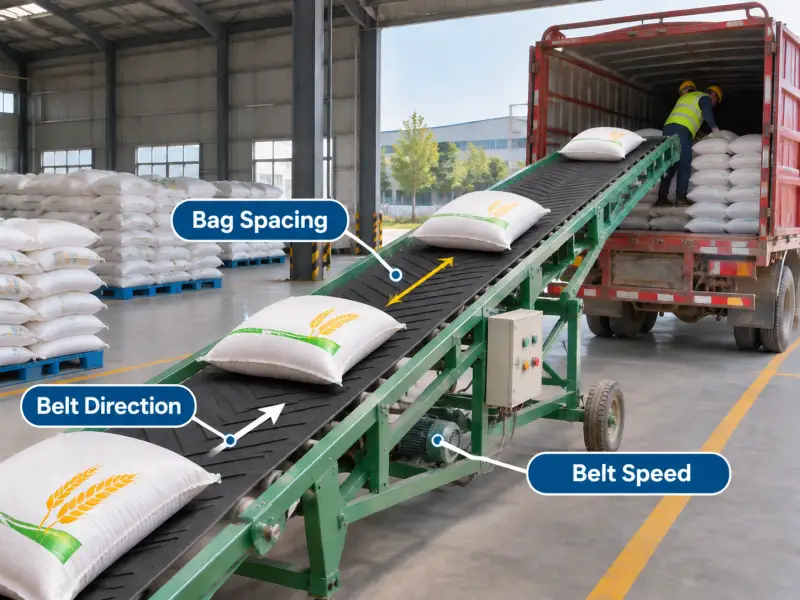
3.2 Bag Pitch and Belt Speed
For one row of bags, calculate the required belt speed as:
belt speed = bag pitch × bags per hour ÷ 3,600
At 1,200 bags per hour and a 0.9 m pitch, the required speed is 0.30 m/s. This value checks whether the line can space the bags without overlap; it does not set belt tension or width.
3.3 Required Operating Data
Input | Required record | Effect on the final belt |
Bag or carton | Mass, dimensions and base condition | Cover pressure, support width and cleat pitch |
Flow | Normal and peak units per hour | Average throughput and bag spacing |
Route | Center distance, lift, incline and transfers | Tension, grip and discharge geometry |
Conveyor | Belt width, pulley diameters and take-up | Carcass class, thickness and splice compatibility |
4. Rubber Conveyor Belts for Bagged Storage
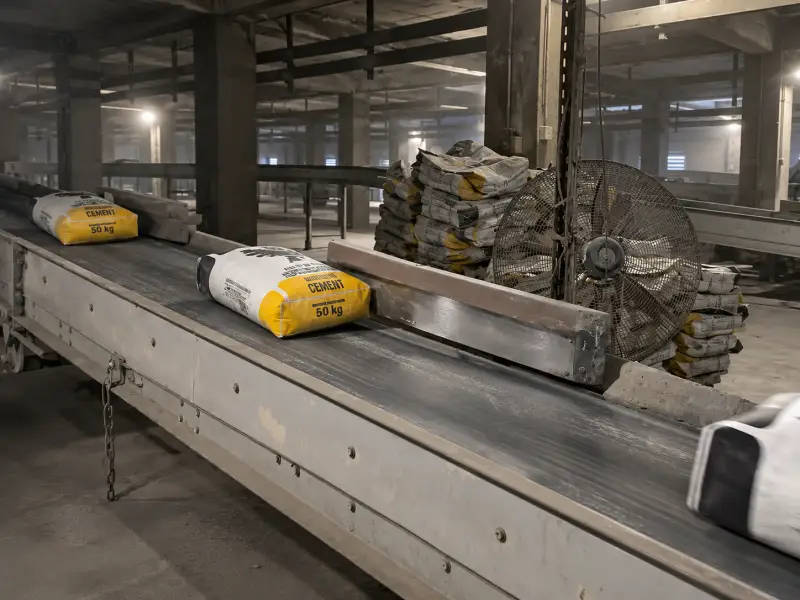
We recommend rubber as the first choice for grain, rice, flour, feed, seed and fertilizer warehouse belts. A fabric carcass carries the load, rubber covers protect it, and reinforced edges resist bag contact at the sides.
4.1 Bagged Rice and Grain Handling
For a rice mill in Southeast Asia, the warehouse belt should carry rice bags from packing into storage and then to dispatch. Record the bag weight, bag dimensions, drop height, incline and spacing between bags before selecting the carcass.
A medium-to-heavy standard is a fabric-carcass rubber belt with an EP or NN construction. The required number of plies comes from the conveyor tension calculation. The carrying cover should suit repeated bag contact, and the edges should resist off-center loading.
4.2 Loading Impact
The impact energy of a falling bag before contact can be estimated as:
E = mgh
Here, E is impact energy in joules, m is bag mass in kilograms, g is 9.81 m/s² and h is vertical drop in meters. A 25 kg bag falling 0.5 m carries about 123 J. A 50 kg bag from the same height carries about 245 J.
The energy value explains why 50 kg bags require a more conservative loading arrangement than 25 kg bags. Support the loading point, centre the chute and avoid direct bag edges striking the belt. A thicker cover provides wear allowance, but it cannot compensate for a badly supported loading zone.
4.3 Cover Surface and Edge Protection
Use a smooth rubber cover for a straightforward bag line where release is the main requirement. Use a rough-top cover where the belt must hold bags on an incline. Use a patterned cover only when its grip and cleaning effect both suit the warehouse.
Edge damage normally appears on the side receiving the greatest bag load or guide contact. Check bag centering, guide clearance and pulley alignment. A replacement belt should include reinforced edge construction where the existing belt shows continuous side wear.
4.4 Inclined Bag Handling
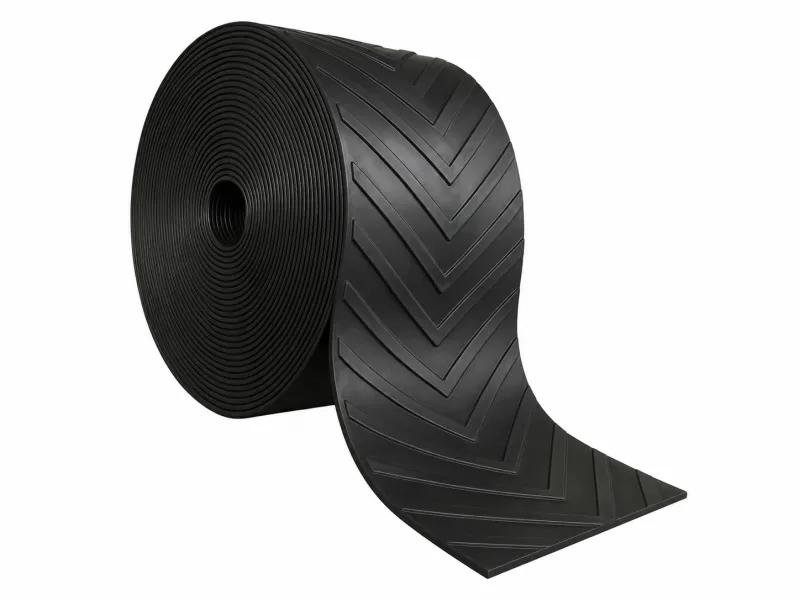
For bag inclines, recommend rough-top belting up to 35° or chevron belting up to 40°. The bag must remain stable at loading, throughout the incline and during discharge. Check the pulley path, side clearance and transfer height before approving either surface.
For steeper or more demanding bag handling, use cleats with a pitch calculated from the bag length:
Minimum cleat pitch = bag length + loading clearance + discharge clearance
5. PVC and PU Belts for Packed Industrial Goods
We recommend PVC/PU as the first choice for general industrial warehouses and distribution centers. These belts provide smooth release, flexible profile fabrication and a practical weight for cartons, totes and wrapped goods.
5.1 PVC Conveyor Belts
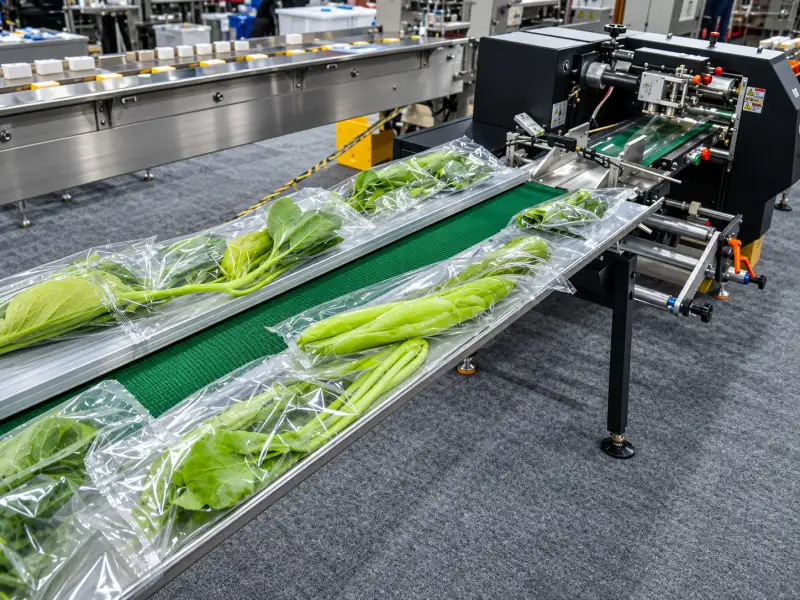
Use PVC belting for cartons, parcel cages, totes and wrapped finished goods. A smooth surface is the standard choice because product release is predictable. A fabric-reinforced construction should be selected for the load and smallest pulley.
5.2 PU Conveyor Belts
Use PU belting where the system requires greater resistance to cutting or tearing in a lighter packed-goods line. PU also allows flexible cleat and guide manufacture. Select the actual grade from the required load, pulley and surface duty.
5.3 Choosing Between PVC and PU
Choose PVC for standard cartons, parcel cages and totes where smooth release is the main requirement. Choose PU when the line needs higher cut or tear resistance and flexible profile construction. Both choices should use fabric reinforcement and a splice that suits the smallest pulley.
6. Conveyor Belt Carcass and Cover Construction
The carcass controls tension capacity and elongation. The covers protect the carcass and define the working surface. Select the carcass, cover and splice as one finished construction.
6.1 Fabric Carcass
EP and NN are the standard fabric carcass families for rubber warehouse belts. The table below shows current standard EP strength classes and the available strength for two to six plies.
Carcass class | Thickness per ply | 2 ply | 3 ply | 4 ply | 5 ply | 6 ply |
EP100 | 1.00 mm | 200 N/mm | 300 N/mm | 400 N/mm | 500 N/mm | 600 N/mm |
EP150 | 1.00 mm | 300 N/mm | 450 N/mm | 600 N/mm | 750 N/mm | 900 N/mm |
EP200 | 1.20 mm | 400 N/mm | 600 N/mm | 800 N/mm | 1,000 N/mm | 1,200 N/mm |
EP300 | 1.60 mm | 600 N/mm | 900 N/mm | 1,200 N/mm | 1,500 N/mm | 1,800 N/mm |
EP630 | 2.60 mm | 1,260 N/mm | 1,890 N/mm | 2,520 N/mm | 3,150 N/mm | 3,780 N/mm |
The values are catalogue strength by construction. For example, an EP200 three-ply belt has a listed strength of 600 N/mm. At a 1,000 mm width, the full-width catalogue strength is 600 kN. This is not the allowable working tension; the conveyor designer must complete the operating tension and safety calculation.
6.2 Top Cover
The standard EP range includes top-cover thicknesses from 1.5 mm to 30 mm. For bagged rice and grain, a moderate top cover with good abrasion resistance and bag release is the practical starting point. Select a thicker cover where loading impact is severe or edge contact is frequent.
6.3 Bottom Cover
The standard EP range includes bottom-cover thicknesses from 0 mm to 20 mm. The bottom cover must handle contact with pulleys, idlers or the slider bed. Use a protected bottom cover where grain dust collects or the return side shows contact wear.
6.4 Strength Verification
Our standard EP construction also lists minimum interply adhesion of 4.5 N/mm mean and 3.9 N/mm lowest value. Cover-to-carcass adhesion is listed as 3.2 N/mm mean for 0.8-1.5 mm cover and 3.5 N/mm mean above 1.5 mm cover.
The same construction data should confirm 10% or more elongation at break and 2% or less reference-load elongation. These values verify a specified construction; they do not replace the conveyor tension calculation.
6.5 Edge Construction
Use a sealed or rubber-edged construction for bagged agricultural storage where side wear is expected. A cut edge is acceptable where the frame and guide arrangement protect the belt. Match the replacement edge type to the approved drawing.
7. Surface and Profile Options
7.1 Smooth and Rough Top Surfaces
Smooth belting is the first choice for horizontal bag and carton lines because it releases products cleanly. Rough-top belting is the first choice for inclined bag lines because it adds grip without using tall profiles.
7.2 Patterned Surfaces
Chevron belting is the first choice for steeper bag inclines. Its raised V pattern improves grip and helps keep bags positioned. Use a smooth or rough-top belt where the incline does not require this additional surface geometry.
7.3 Cleated Belts
Use cleats for steep bag inclines or for a controlled sequence of bags. Cleat pitch is set from bag length plus loading and discharge clearance. Cleat height must clear the pulleys, guards and transfer structure.
7.4 Sidewalls and Guide Profiles
For packed bag lines, choose cleats ahead of sidewalls. Sidewalls are intended mainly for loose or small materials and are not the normal choice for whole bags. Use side guides only to keep the bag near the center of the belt and confirm clearance with the belt edge.
8. Final Selection Checks
8.1 Carcass and Pulley Check
Confirm the calculated operating tension, belt width, smallest pulley and take-up range together. An EP or NN class that carries the load may still be unsuitable if it is too thick to flex around the pulley or cannot be joined within the available installation space.
8.2 Loading and Tracking Check
Confirm that the chute lands bags near the center of the belt. Check that the heaviest bag remains stable during acceleration and that the belt edge does not run against a fixed guide. Correct the line before increasing belt tension.
8.3 Surface and Discharge Check
Confirm that the selected surface grips the bag on the incline and still releases it at the discharge. Check cleat or profile clearance through every transition. Approve the splice at the same time because joint thickness can change the belt path.
9. Custom Warehouse Conveyor Belts
Customization should follow a simple sequence: define the application, measure the conveyor, specify the belt construction and approve the drawing before production.
9.1 Dimensions and Materials
Specify width, open length or endless inner circumference, total thickness and cover thickness. State rubber, PVC or PU and the proposed carcass. Provide the maximum bag or package weight and peak throughput.
9.2 Surface and Profiles
Specify smooth, rough-top or chevron surface. For cleats, guides and sidewalls, provide a dimensioned sketch showing height, width, length, pitch, position and running direction. State the minimum pulley the finished belt must pass.
9.3 Drawing and Sample Approval
Approve a drawing before production. The drawing should show belt dimensions, splice allowance, edge type, surface direction and every accessory. An old belt sample may be used to confirm cover and fabric construction, but measured conveyor dimensions remain necessary.
9.4 Packaging and Delivery
Confirm quantity, packaging, identification and delivery requirements with the order. Roll open belts with controlled bending and protect endless belts against crushing. Check the delivery date against installation access and the planned shutdown.
10. Conclusion
For warehouse belts carrying packed grain, rice, flour, feed, seed or fertilizer, choose rubber first. For general industrial and distribution warehouses carrying cartons or totes, choose PVC/PU first. Confirm the final carcass strength, pulley compatibility and splice from the installed line data.
11. Frequently Asked Questions
1. Do More Plies Always Mean a Stronger Finished Belt?
No. For the same EP class, the catalogue strength increases with ply count, but a different fabric class or construction can change the comparison. Compare the rated strength, elongation, cover, adhesion and splice together. Ply count alone does not define a replacement belt.
2. What Should Be Checked During the First Loaded Run?
Watch bag centering, belt tracking, splice passage, drive slip, cover contact and release at the discharge. Check the loading point for bouncing or trapped bag corners. Stop and correct the line if the belt shifts toward one edge or a bag changes position between cleats.
3. Why Can Two Belts With the Same Width and Thickness Perform Differently?
Width and total thickness do not show fabric type, ply count, cover compound, adhesion or splice construction. Two belts can fit the same frame and still have different strength, elongation and wear behavior. Compare the complete datasheet and approved drawing.
4. What Maintenance Record Prevents Repeated Belt Selection Errors?
Keep the approved drawing, carcass class, ply count, cover thicknesses, edge type, surface, profile dimensions, splice type and installed length. Add the first inspection thickness readings and bag-loading conditions. These records make the next replacement comparable.
5. When Should a Warehouse Use a Modular Belt Instead of a PVC/PU Belt?
Choose a modular belt where positive sprocket drive, open drainage or a fixed tote pattern is essential. It requires different sprockets, shafts, frame support and transfer design. For normal packed cartons, totes and industrial goods, a fabric-reinforced PVC/PU belt remains the recommended choice.