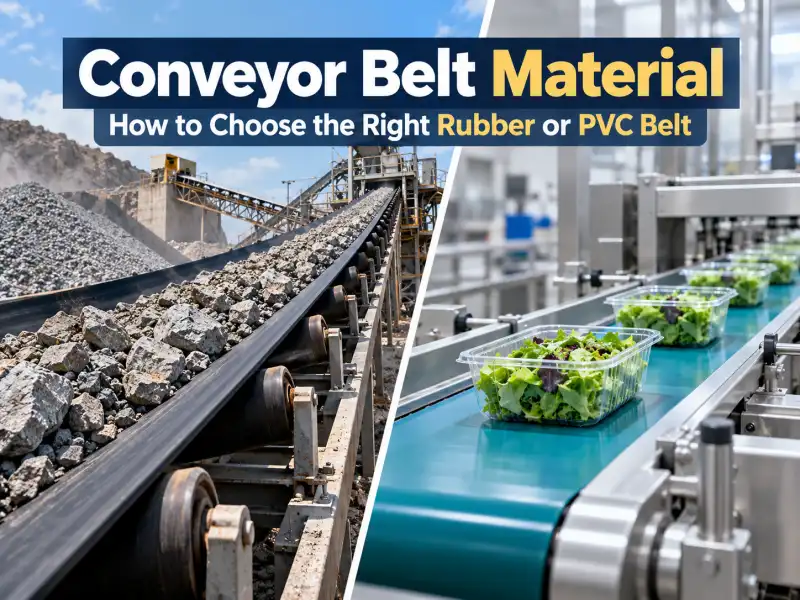
If you compare an EP conveyor belt with an NN conveyor belt only by tensile strength or price, you can easily choose the wrong construction. The main engineering difference is not that one carcass is universally “stronger.” It is how the two fabrics stretch, recover, absorb impact, and interact with your take-up, pulleys, loading zone, and splice.
In most applications, an EP belt is the first option when you need low longitudinal elongation, stable tracking, and limited take-up movement. An NN belt becomes attractive when you need greater elasticity and fatigue resistance under repeated bending or impact—and the conveyor has enough take-up capacity to manage its higher stretch.
That is only the starting point. Two belts with the same nominal strength, such as EP 500/4 and NN 500/4, are not automatically interchangeable. Their elongation behavior, ply construction, pulley requirements, splice design, cover compound, and allowable working tension still need to match the conveyor.
This guide explains those differences and gives you a practical method for selecting a new belt or evaluating an EP-to-NN or NN-to-EP replacement.
1. Quick Answer: EP vs NN Conveyor Belt
Comparison point | EP conveyor belt | NN conveyor belt | What it means for your conveyor |
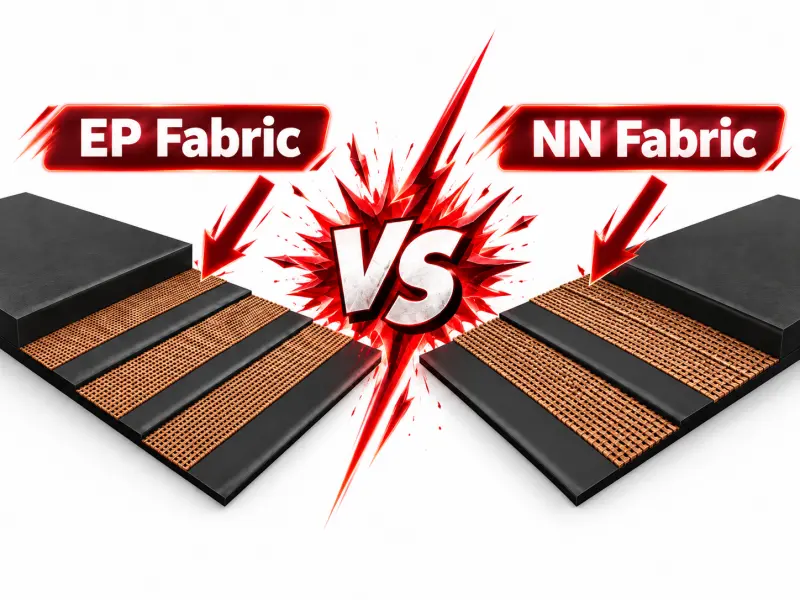
Carcass fabric | Polyester warp and polyamide/nylon weft | Nylon warp and nylon weft | The warp difference drives most longitudinal behavior |
Nominal tensile strength | Available in many strength ratings | Available in many strength ratings | Neither is inherently stronger; compare the actual belt rating and construction |
Longitudinal elongation | Generally lower | Generally higher | EP usually needs less take-up travel and fewer tension corrections |
Dimensional stability | Generally higher | Generally lower under sustained load | EP is often easier to manage on long or high-tension conveyors |
Elasticity and dynamic response | Moderate and construction-dependent | Generally higher | NN can absorb repeated impact and flexing well |
Troughability | Depends on the complete belt construction | Often very flexible, but still construction-dependent | Verify the finished belt test data rather than selecting by fabric code alone |
Moisture response of the reinforcement | Polyester warp absorbs less moisture | Nylon warp absorbs more moisture | Edge sealing, cover condition, and splice quality remain critical in wet service |
Take-up demand | Usually lower | Usually higher | Confirm available travel before changing from EP to NN |
Abrasion, heat, oil, and flame resistance | Primarily determined by the cover compound and belt design | Primarily determined by the cover compound and belt design | Do not use EP or NN as a substitute for the correct cover grade |
Typical selection tendency | Long runs, high tension, restricted take-up, stable operation | Severe dynamic loading, repeated flexing, adequate take-up | This is a tendency, not a universal rule |
Read this table as a screening tool, not a specification. It describes common tendencies. Your specific belt may sit outside them. If you need one line: choose EP when length stability and limited take-up travel matter most. Evaluate NN when repeated impact and flexing dominate and your take-up can absorb more stretch.
Abrasion, heat, oil, chemical, and flame performance come mainly from the cover rubber and the full belt design. The carcass type alone does not set them. Confirm those requirements separately before you compare EP with NN.
Two belts can share the same nominal strength and ply count. They can still differ in elongation, thickness, troughability, and pulley requirements. Compare the finished belt data, not just the EP or NN name.
2. What Do EP and NN Mean in a Conveyor Belt?
EP and NN describe the textile reinforcement inside a rubber conveyor belt. This reinforcement is called the carcass. It carries tension, supports the load, and helps the belt resist impact and repeated flexing.
The rubber covers have a different job. They protect the carcass from wear, cutting, heat, oil, chemicals, weather, and other service conditions. Separating carcass performance from cover performance is essential because many incorrect comparisons attribute cover properties to the fabric code.
2.1 EP belt construction
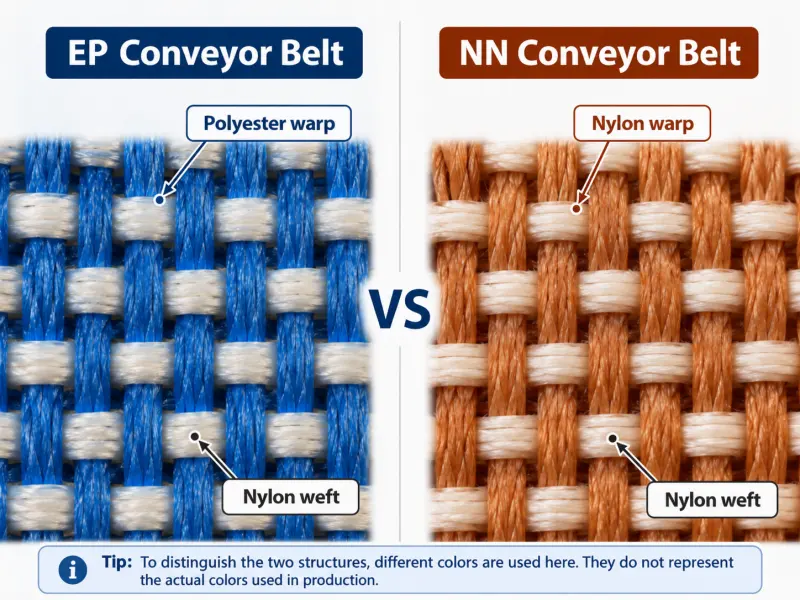
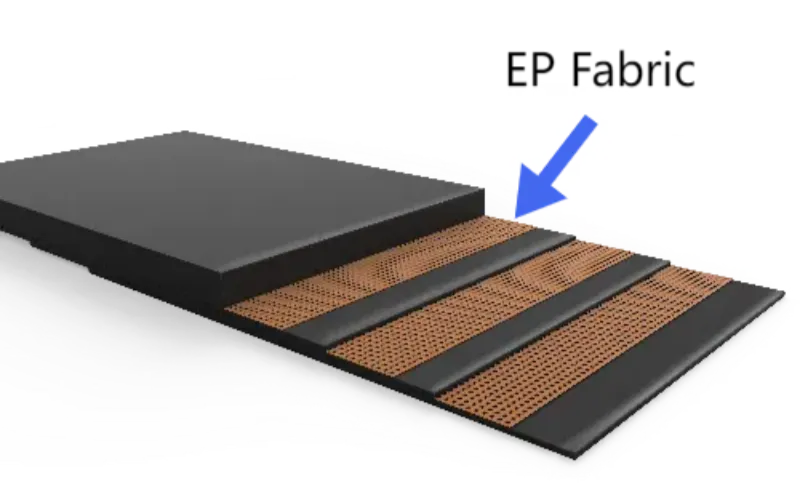
In an EP fabric, the longitudinal—or warp—yarns are polyester. The transverse—or weft—yarns are polyamide, commonly called nylon.
- Erefers to polyester.
- Prefers to polyamide.
- The polyester warp gives the belt relatively low longitudinal elongation and good dimensional stability.
- The nylon weft gives the carcass transverse flexibility and helps it resist impact and tearing.
EP is therefore not an all-polyester belt. It is a deliberately balanced polyester/nylon construction. The term EE refers to polyester in both directions, which is a different product.
2.2 NN belt construction
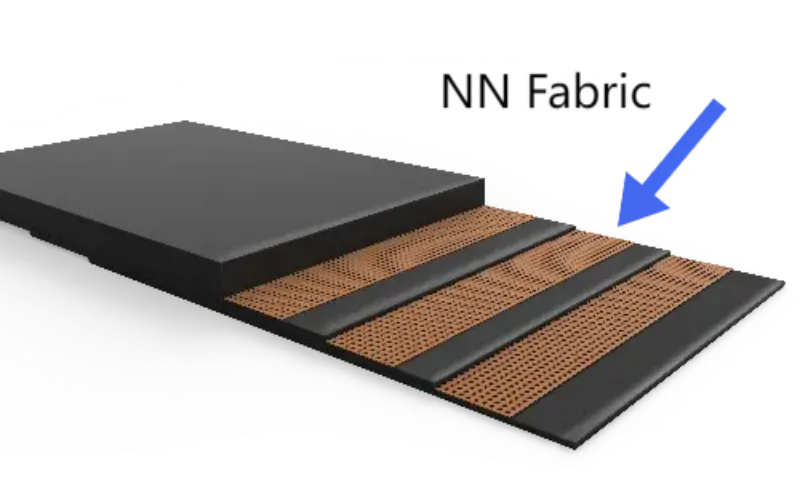
An NN carcass uses nylon in both the warp and the weft directions.
- The nylon warp gives it greater longitudinal elasticity.
- The nylon weft supports transverse flexibility and dynamic fatigue resistance.
- The all-nylon construction can perform well where the belt is exposed to repeated impact, bending, or changing loads.
Its higher elongation is not automatically a defect. It becomes a disadvantage only when the take-up system, belt length, or operating conditions cannot accommodate it.
2.3 What the carcass controls—and what the cover controls
The carcass and the cover rubber do different jobs. Buyers who mix them up often end up specifying the wrong belt.
The carcass carries the load and sets the belt’s mechanical behavior:
- Tensile strength
- Working elongation and permanent elongation
- Elastic modulus and dimensional stability
- Troughing and bending performance
- Impact and fatigue response
- Splice design
The cover rubber protects the carcass and sets most surface performance:
- Abrasion resistance
- Cut and gouge resistance
- Heat resistance
- Oil and chemical resistance
- Flame resistance
- Weathering and aging behavior
That split has a practical consequence for purchasing. A quotation should state the carcass type, the ply count, and the cover grade as separate items. When you compare two offers, compare all three, because strength alone will not tell you how the belt behaves.
2.4 Carcass type is only one part of the specification
A complete fabric belt specification should also identify:
- Full-thickness tensile strength;
- Number of plies and fabric construction;
- Belt width and total thickness;
- Top and bottom cover thicknesses;
- Cover grade;
- Elongation characteristics;
- Ply adhesion and cover adhesion;
- Edge construction;
- Splice method; and
- Any special breaker, rip-resistant layer, or other reinforcement.
Two belts labeled EP may behave differently if their yarn design, ply count, skim rubber, covers, or manufacturing quality differ. The same applies to two NN belts.
If the belt marking is missing or ambiguous, do not identify the fabric by color, surface appearance, or total thickness alone. Check the belt edge marking, bottom-cover marking, purchase documents, test certificate, and splice records. If those are unavailable, send a representative sample to the original manufacturer or a qualified belt laboratory.
3. The Main Engineering Difference: Longitudinal Behavior
The warp yarns carry most of the belt tension. Because EP uses polyester warp and NN uses nylon warp, their most important difference appears in the longitudinal direction.
Polyester normally stretches less under working load. Nylon normally stretches more and has a more elastic response. This affects far more than the laboratory elongation figure: it changes take-up movement, tension stability, start-up behavior, tracking sensitivity, splice planning, and replacement compatibility.
3.1 Tensile strength: neither carcass is automatically stronger
It is misleading to say that EP is always stronger than NN, or that NN is always stronger than EP. Both carcass types can be manufactured in different strength ratings.
For example, an EP 500/4 belt and an NN 500/4 belt may both be specified with a nominal full-thickness tensile strength of 500 N/mm. The fabric type tells you how the reinforcement is built; the strength designation tells you its rated breaking strength per unit of belt width.
Before comparing tensile strength, identify what the stated rating represents. Supplier documents may refer to:
- Fabric strength per ply:the nominal strength of an individual fabric layer.
- Finished-belt tensile strength:the specified longitudinal strength of the complete cured belt across each millimeter of width.
- Allowable working tension:the design tension permitted during conveyor operation.
A finished-belt rating in N/mm is verified through a destructive full-thickness tensile test. It represents strength near failure, not the tension the belt should carry continuously.
Allowable working tension must account for:
- The applicable safety factor;
- Steady-state and starting tension;
- Transient or braking tension;
- Splice efficiency;
- Belt construction and service category;
- Conveyor geometry; and
- The relevant design standard.
There is also a naming risk. In many markets, a designation such as EP 500/4 refers to the complete belt strength and four plies. Some suppliers also use terms such as EP 200 to describe a per-ply fabric class. Before comparing quotations, ask each supplier whether the number refers to total finished-belt strength or strength per ply.
If the notation is unclear, the technical and price comparison is unreliable.
3.2 Elongation is not one number
When a data sheet says “elongation,” determine which property it means. The following values answer different engineering questions:
Elongation property | What it measures | How you should use it |
Elongation at break | Extension when the specimen reaches failure | Evaluate failure behavior, not normal running stretch |
Elongation at reference force | Extension under a specified comparison load | Compare finished belts under equivalent test conditions |
Elastic elongation | Recoverable extension after unloading | Assess belt response as operating tension changes |
Permanent elongation | Length increase that remains after unloading | Estimate long-term consumption of take-up travel |
Elastic modulus | Relationship between load and extension | Compare belt stiffness under tension |
EP belts generally show lower longitudinal extension under load and lower permanent growth than comparable NN belts. However, a generic percentage copied from a sales page is not sufficient for conveyor design. Request test data for the exact finished belt construction you plan to buy.
Do not estimate take-up travel by multiplying conveyor center distance by a generic elongation percentage. Belt length in the tension system, permanent growth, elastic stretch, splice allowances, installation tension, temperature, and take-up geometry all affect the required carriage travel.
3.3 Dimensional stability and take-up demand
Lower longitudinal stretch helps an EP belt maintain a more stable operating length. This can provide practical advantages:
- Less take-up movement;
- Fewer manual re-tensioning interventions;
- Lower risk of exhausting a short take-up stroke;
- More consistent belt tension; and
- Easier control on long conveyors or systems with limited adjustment.
An NN belt normally needs more take-up allowance. If adequate travel is available, its elasticity can be useful. If the take-up reaches the end of its stroke, however, the conveyor may lose effective tension. The result can include drive slip, unstable tracking, poor start-up, excessive sag, or material spillage.
The take-up type matters as much as the belt fabric. A fixed or screw take-up with short travel creates different constraints from a correctly sized gravity or automatic take-up. Before replacing EP with NN, document both the available take-up travel and the calculated requirement.
Also check:
- Total mechanical travel;
- Current take-up position under normal operating tension;
- Remaining movement in the tensioning direction;
- Initial installation position;
- Previous adjustment history;
- Whether the belt can be shortened and respliced; and
- Elastic and permanent elongation of the proposed belt.
A higher-elongation replacement may operate normally after installation because sufficient tension can initially be applied. Problems may appear later as permanent elongation consumes the remaining adjustment range.
3.4 Impact resistance and flex-fatigue are different problems
Loading-point impact and flex-fatigue are not the same failure mechanism. Impact occurs when material strikes the belt, while flex-fatigue develops as the belt repeatedly bends and straightens around pulleys and idlers. A construction that handles one condition well may still require additional checks for the other.
NN carcasses are often selected for their high elasticity, toughness, and resistance to repeated flexing. These characteristics can be valuable where large lumps strike the loading zone or the belt cycles repeatedly around pulleys.
This does not mean that every impact application requires NN. A standard EP carcass already contains nylon in the transverse direction and can provide good impact performance. In many severe loading zones, the following factors influence belt damage more than the letters EP or NN:
- Lump mass, shape, and sharpness;
- Material drop height and relative velocity;
- Chute design and loading direction;
- Top-cover grade and thickness;
- Carcass strength and ply construction;
- Breaker or rip-resistant reinforcement;
- Impact idlers or impact beds; and
- Belt support and sag at the loading point.
For loading-point impact, assess:
- Maximum lump size, weight, and shape;
- Sharpness of the material;
- Drop height and loading direction;
- Relative speed between the material and belt;
- Top cover thickness and compound;
- Chute trajectory;
- Support beneath the belt; and
- Impact idlers or impact beds.
For flex-fatigue, focus on:
- Pulley diameter;
- Belt thickness;
- Ply construction;
- Splice geometry;
- Belt tension; and
- The number of bending cycles.
If the belt is repeatedly punctured or its plies break beneath the loading chute, changing the carcass alone may not solve the problem. The loading trajectory and belt support may still be incorrect. Breaker fabric or rip-resistant reinforcement can improve impact protection, but added reinforcement may also increase stiffness and pulley requirements.
A working order is useful:
- Reduce the drop, or guide the material in the chute so it lands closer to belt speed.
- Support the belt through the impact zone with an impact bed or closely spaced impact idlers.
- Increase top cover thickness and grade for the cut and gouge load.
- Only then consider NN or a breaker ply if the carcass is still the limiting item.
Fixing the loading zone costs money once and consumes no take-up travel. Selecting NN to survive an impact consumes take-up travel for the whole life of the belt. If your take-up is already short, the loading-zone route is usually cheaper.
3.5 Troughability, flexing, and pulley diameter
Troughability is the belt’s ability to conform to a troughed idler set while maintaining contact and containing material. NN is commonly described as more flexible, but carcass code alone does not determine whether a particular belt will trough correctly.
The finished belt’s width, thickness, ply count, fabric design, cover thickness, transverse rigidity, and trough angle all matter. A belt that is too stiff for its width can lift away from the center roll when lightly loaded. A belt that lacks sufficient transverse support can deform excessively under load.
A 45-degree troughing set bends the belt deeper than a 30-degree set. The same belt can seat correctly on one conveyor and stay nearly flat on another. When the belt loses contact with the center idler, the load rides on the outer rollers. The belt then sags between them.
Which belt troughs well is set by the construction, not the fiber family. Two belts with the same carcass type can trough very differently once covers and thickness change. NN is usually the more flexible option, but a heavy NN belt troughs worse than a light EP belt.
Small-pulley claims also require caution. A flexible NN construction may perform well around relatively small pulleys, but the minimum permissible pulley diameter must be obtained for the exact finished belt and the pulley duty. Drive, tail, bend, and take-up pulleys do not necessarily have the same minimum diameter.
Bending strain in the plies rises as pulley diameter falls and as belt thickness rises. Minimum pulley diameter therefore depends on the belt construction—ply count, thickness, and splice type—not on the carcass fiber. A mechanical fastener usually needs a larger diameter than a vulcanized splice.
The transition from troughed to flat at each pulley belongs to the same check. A transition that is too short forces the edges to bend at a radius they were not designed for. Repeated forced bending at the wrong radius is a common route to ply fatigue and splice failure.
Use finished-belt troughability data and the manufacturer’s minimum-pulley table. Do not approve a smaller pulley only because the belt is labeled NN.
3.6 Moisture and wet environments
Polyester fibers absorb less moisture than nylon fibers. Because EP has polyester in the load-carrying warp direction, it generally provides more stable longitudinal behavior when moisture reaches the reinforcement.
The mechanism is simple. Moisture swells the yarns. In an NN belt, the swelling acts on the warp, which runs lengthwise. The belt grows longer, and the take-up has to absorb that growth. The symptom shows up as a belt that was correctly tensioned when dry needing repeated retensioning after a wet period.
In a well-manufactured, undamaged belt, however, the rubber covers, skim layers, edges, and splice should protect the carcass. Wet-service reliability therefore also depends on:
- Sealed or molded edges where appropriate;
- Cover and skim adhesion;
- Absence of cuts and edge damage;
- Splice sealing and workmanship; and
- Storage and installation practices.
EP is often a sensible choice for humid or wet operation, especially when dimensional stability matters. But “wet environment” alone is not a complete belt specification.
If a belt starts growing in service after a wet season, inspect the edges and the splice before blaming the fiber. A damaged edge lets water into the carcass, and switching from EP to NN will not repair that.
3.7 Abrasion, cutting, heat, oil, chemicals, and flame
These service properties are often assigned incorrectly to the carcass fabric. In most rubber conveyor belts, the cover compound and overall belt design provide the primary resistance to the conveyed material and environment.
- For abrasive rock, select the required abrasion and cut-resistant cover.
- For hot material, specify the temperature range and a heat-resistant compound.
- For oily material, specify the oil type, exposure, and compatible cover.
- For underground or regulated service, specify the required flame or safety classification.
- For acids, alkalis, or other chemicals, provide the chemical, concentration, and temperature.
For hot materials, confirm the normal and peak material temperatures, measurement point, contact duration, belt speed, cooling conditions, and complete heat-resistant belt construction.
For oily or chemical materials, identify the substance, concentration, temperature, and duration of exposure. Different oils and chemicals can affect rubber compounds differently.
Where flame or antistatic performance is required, confirm the specific operating environment and required test evidence. A general description such as “flame-resistant” may not define every safety requirement.
After selecting the correct cover system, choose EP or NN according to the conveyor’s mechanical demands. An NN carcass is not automatically more abrasion-resistant, and an EP carcass is not automatically a heat-resistant belt.
3.8 Splicing
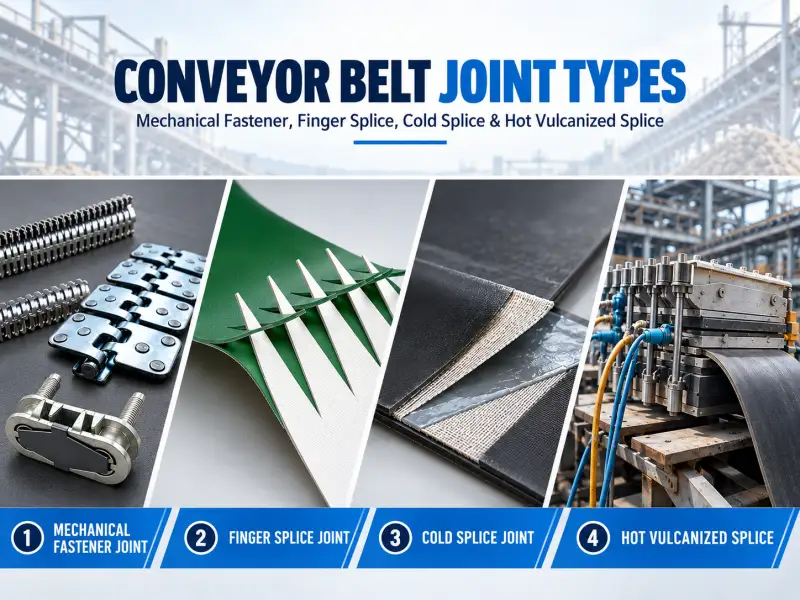
Both EP and NN fabric belts can use hot vulcanized, cold-bonded, or mechanical splices when the belt manufacturer and operating conditions allow them. No splice method should be considered interchangeable without checking the belt construction.
Changing the carcass type can change the splice design even when belt width and nominal tensile strength remain unchanged. Differences in ply count, individual ply thickness, total carcass thickness, modulus, and bonding system can affect the required splice geometry.
For a replacement belt, confirm:
- Number of plies and step arrangement;
- Step length and total splice length;
- Splice angle and construction;
- Compatible rubber, cement, or fastener system;
- Curing pressure, temperature, and time where applicable;
- Expected splice efficiency; and
- Whether the existing vulcanizing equipment can produce the required splice.
The splice description should state the method—hot, cold, or mechanical—the step count and step length, and the direction rule that keeps the warp running along the belt. Direction is not a small detail: a step splice laid out against the warp does not develop the strength of a correctly oriented joint.
A nominally equivalent belt that requires a longer splice may not fit the available work area. A change in fabric or ply construction may also require a revised splice procedure.
3.9 Weight, price, energy use, and service life
There is no reliable universal rule that NN is lighter or cheaper, or that EP is heavier or more expensive. Belt mass and quotation price depend on width, total strength, ply count, covers, rubber formulation, manufacturing route, order quantity, and market conditions.
Energy consumption also cannot be predicted from EP or NN alone. Indentation rolling resistance, belt mass, idler condition, alignment, tension, loading, and conveyor geometry all contribute.
The lowest purchase price is not necessarily the lowest operating cost. Compare expected service life, splice and installation labor, tensioning work, planned downtime, stock compatibility, and the cost of an unplanned stoppage.
4. How the Difference Affects Conveyor Operation
4.1 Long or high-tension conveyors
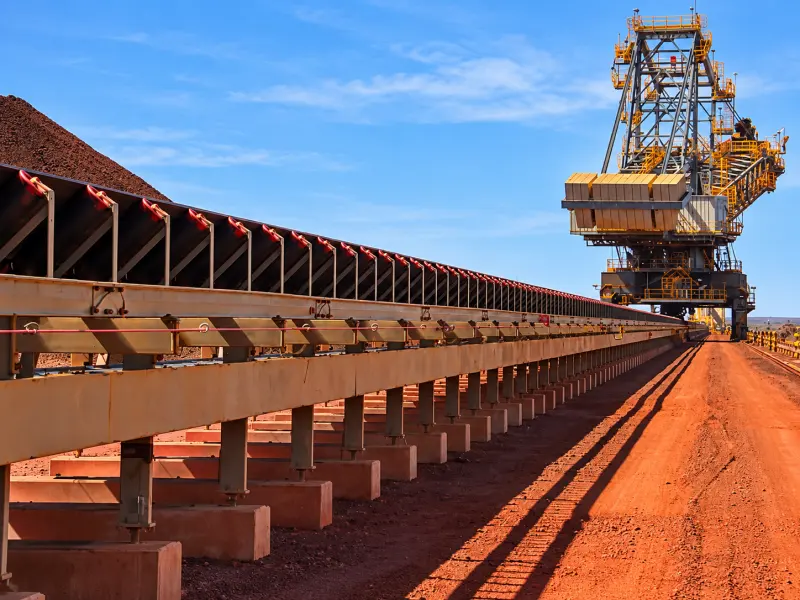
As a conveyor becomes longer or operates at higher tension, control of belt stretch becomes increasingly important. EP is commonly preferred because its lower longitudinal elongation reduces take-up demand and helps stabilize the system.
Two effects grow with conveyor length. Elongation is a percentage of belt length, so the absolute stretch the take-up must absorb rises with the center distance. The tension needed to move the same tonnage also rises with length and lift.
Length alone is not a pass/fail rule. There is no technically sound universal threshold at which every conveyor below a certain distance should use NN and every conveyor above it should use EP. Tension, lift, drive arrangement, starting method, load, take-up design, and belt construction must be considered together.
A long, lightly loaded conveyor may impose less tension than a shorter inclined conveyor. If the calculated tension exceeds the practical range of a fabric belt, neither EP nor NN may be the appropriate construction.
4.2 Short conveyors with severe dynamic loading
On a shorter conveyor with sufficient take-up travel and severe repeated impact, an NN belt may be a strong candidate. Its elasticity and fatigue response can help it tolerate dynamic loading.
A short belt loop usually produces less absolute length change, so a conveyor with sufficient take-up travel may accommodate the higher elongation of an NN belt more easily. NN is therefore worth evaluating when repeated severe impact is the main mechanical demand.
Even here, verify the top cover, loading-zone support, pulley diameters, and splice. Short distance does not make every NN belt suitable, just as impact does not make every EP belt unsuitable.
Short conveyors often use screw take-ups, small pulleys, and restricted installation space. These conditions can limit the available adjustment and affect belt or splice flexibility. You still need to verify the exact elongation, pulley requirements, and remaining take-up travel.
4.3 Conveyors with limited take-up travel
If a conveyor has a short screw take-up or little remaining gravity take-up travel, lower elongation can be decisive. EP is normally easier to accommodate, but the final choice should use the supplier’s finished-belt elongation data and a take-up calculation.
Changing an existing EP belt to NN without this check is one of the highest-risk substitutions. The new belt may run initially and then exceed the available adjustment after permanent growth and operating stretch develop.
For a conveyor with restricted take-up travel, the important value is the usable movement remaining after installation—not simply whether the system uses a screw or gravity take-up.
Check:
- Total mechanical travel;
- Current take-up position under normal operating tension;
- Remaining movement in the tensioning direction;
- Initial installation position;
- Previous adjustment history;
- Whether the belt can be shortened and respliced; and
- Elastic and permanent elongation of the proposed belt.
EP is usually the safer starting direction when available travel is limited, but you should still verify the offered finished-belt data. The EP designation alone does not guarantee that its elongation matches the existing take-up system.
4.4 Combined long-distance and high-impact service
Real conveyors often combine conflicting requirements. A long overland or plant conveyor may also receive large, sharp material at a transfer point.
On a long conveyor, elongation affects the entire belt loop, while severe impact is usually concentrated at one or several loading points. This difference is important: you do not necessarily need to change the behavior of the whole belt to solve a localized impact problem.
Do not resolve this by choosing one generic advantage and ignoring the other. A common engineering approach is to use a low-elongation EP carcass sized for the system tension, then improve impact performance with the appropriate cover, carcass construction, breaker, chute, and loading support. A specially engineered NN construction may also work if the tension and take-up system are designed for it.
The correct answer comes from the complete system, not a two-column material comparison.
Additional reinforcement is not automatically better. It can increase belt thickness, stiffness, weight, minimum pulley requirements, and splice complexity. The loading-zone protection must remain compatible with the rest of the conveyor.
5. EP or NN: A Practical Selection Matrix
Operating condition | Usual starting preference | Reason | Checks before approval |
Long conveyor or high working tension | EP | Lower longitudinal elongation and stable length | Calculated tensions, safety factor, take-up, splice, pulley diameters |
Limited take-up travel | EP | Lower expected take-up demand | Exact permanent and elastic elongation data |
Repeated severe impact or flexing | NN may be considered | Higher elasticity and dynamic fatigue resistance | Drop conditions, cover, breaker, impact bed, take-up margin |
Long conveyor with severe loading-zone impact | Often EP with an engineered impact package | Balances stretch control with local damage protection | Chute, lump energy, cover, reinforcement, belt support |
Wet or humid operation | Often EP | Lower moisture absorption of polyester warp | Edge, cover, skim, and splice integrity |
Abrasive material | Either | Abrasion is mainly a cover-grade issue | Abrasion class, cut/gouge risk, cover thickness, material shape |
Hot, oily, chemical, or flame-regulated service | Either | Special cover and belt certification are primary | Temperature, media, duration, safety standard, supplier evidence |
Small pulleys or steep troughing demand | No automatic winner | Complete belt flexibility controls compatibility | Manufacturer’s minimum diameters and troughability data |
Proven existing belt with acceptable life | Usually match the proven construction | Reduces replacement uncertainty | Confirm markings, failure history, and whether conditions changed |
Use this table to identify a starting direction, not to issue a purchase order. The final specification must be checked against the actual conveyor data.
6. Can You Replace an NN Belt With an EP Belt—or EP With NN?
Yes, substitution can be possible, but matching width and nominal strength is not enough. Treat a carcass change as an engineering review.
6.1 Replacing EP with NN
The main concern is normally the higher longitudinal elongation of the NN construction. The main risk is elongation, not strength. NN usually stretches more under the same tension, and that stretch has to be absorbed somewhere. If the conveyor was laid out for an EP belt, the take-up may not have the travel to absorb it.
The failure is slow, which is what makes it dangerous. The belt runs acceptably at installation and for a period afterward. Then permanent elongation accumulates, the take-up reaches its limit, and the belt loses effective tension. From that point you see the symptoms rather than the cause: slip at the drive pulley, growing sag between idlers, unstable starting, mistracking, and spillage.
Check:
- Available and required take-up travel;
- Start-up, running, and braking tension;
- Risk of pulley slip or excessive sag;
- Remaining adjustment after installation and splice settling;
- Tracking behavior and transition geometry;
- Minimum pulley diameters; and
- The supplier’s elastic and permanent elongation data.
If the system was designed around the limited stretch of EP, an equal-strength NN belt may not be operationally equivalent.
6.2 Replacing NN with EP
An NN-to-EP change may reduce take-up demand, but it is not automatically risk-free. This direction looks easier, and in one respect it is. Lower elongation reduces take-up demand, cuts belt length change, and improves dimensional stability. On a conveyor that keeps running out of take-up travel, that can be the fix.
The new risk is stiffness. An EP belt is less forgiving in bending and impact, so check the other side of the system:
- Impact and fatigue demands at the loading zone;
- Compatibility with pulley diameters and repeated flexing;
- Finished-belt troughability;
- Transition distances;
- Splice design and available splice area; and
- Whether the new belt’s tension response changes load sharing or start-up behavior.
Lower stretch is useful only when the complete belt can still flex, trough, splice, and absorb the system’s dynamic loads correctly.
6.3 Twenty checks before approving either substitution
- Confirm belt width, installed length, and required roll lengths.
- Confirm whether the stated N/mm rating is total belt strength or per-ply strength.
- Compare full-thickness tensile strength and the number and design of plies.
- Compare elongation at the specified reference force.
- Review elastic and permanent elongation where the change affects take-up or tension control.
- Recalculate required take-up travel for the proposed belt and take-up arrangement.
- Verify drive, tail, bend, snub, and take-up pulley diameters.
- Verify troughability, idler angle, belt width, and transition distances.
- Check steady-state, starting, stopping, and transient tensions.
- Approve the splice method, dimensions, materials, and expected efficiency.
- Match top and bottom cover grades and thicknesses to the service.
- Review the loading zone, failure history, and any applicable safety or regulatory requirements.
- Confirm total installed length and length per roll.
- Confirm carcass fabric type and construction.
- Confirm elastic modulus and starting-tension behavior.
- Confirm wet-to-dry length change if the belt runs wet.
- Confirm minimum pulley diameter for every pulley position.
- Confirm transition length from troughed to flat.
- Confirm loading-point impact conditions.
- Confirm inspection, traceability, and certification documents.
Ask the belt manufacturer or conveyor engineer to approve the change in writing when the conveyor is critical, high-tension, personnel-sensitive, or subject to regulated service.
7. Common EP vs NN Selection Mistakes
7.1 “NN is stronger than EP”
Fabric chemistry does not establish the belt’s nominal tensile rating. EP and NN carcasses are both built in a wide range of grades, and a higher-grade EP belt will outperform a lower-grade NN belt. Compare N/mm strength, construction, test data, and allowable working tension.
7.2 “EP is always for heavy duty and NN is for light duty”
Both are available in heavy-duty constructions. The choice is more closely related to stretch, dynamic behavior, and system compatibility than to a simple light-versus-heavy classification. EP resists length change. NN absorbs impact and repeated bending. A conveyor that selects NN for impact tolerance is not selecting a lighter belt.
7.3 “NN is more wear-resistant”
The running surface is rubber, not exposed carcass fabric. Cover formulation and thickness primarily determine abrasion, cut, and gouge performance. The carcass sits behind the cover. It only becomes a wear question after the cover is already gone.
7.4 “EP is a heat-resistant belt”
Polyester and nylon have different thermal behavior, but hot-material service requires a suitable heat-resistant cover and complete belt design. “EP” by itself is not a temperature rating.
7.5 “A screw take-up means either belt will work”
The decisive question is how much usable travel the take-up provides compared with the belt’s actual installation and operating elongation. A short screw take-up can make higher-stretch substitutions especially difficult. The take-up type does not decide this. The available travel does.
7.6 “The conveyor is short, so choose NN”
Distance is only one variable. A short conveyor may still have high tension, small pulleys, limited take-up, difficult transitions, hot material, or a demanding splice. Short is not the same as easy.
7.7 “The same strength and ply count mean a direct replacement”
Equal N/mm and ply count do not confirm equal elongation, ply thickness, overall thickness, troughability, pulley compatibility, cover performance, or splice design.
7.8 “One carcass is always cheaper”
Price depends on the complete belt and commercial conditions. Compare technically compliant quotations on the same specification and evaluate total installed cost. Include installation, splicing, tension adjustments, downtime, and service life.

8. Information to Include in Your RFQ
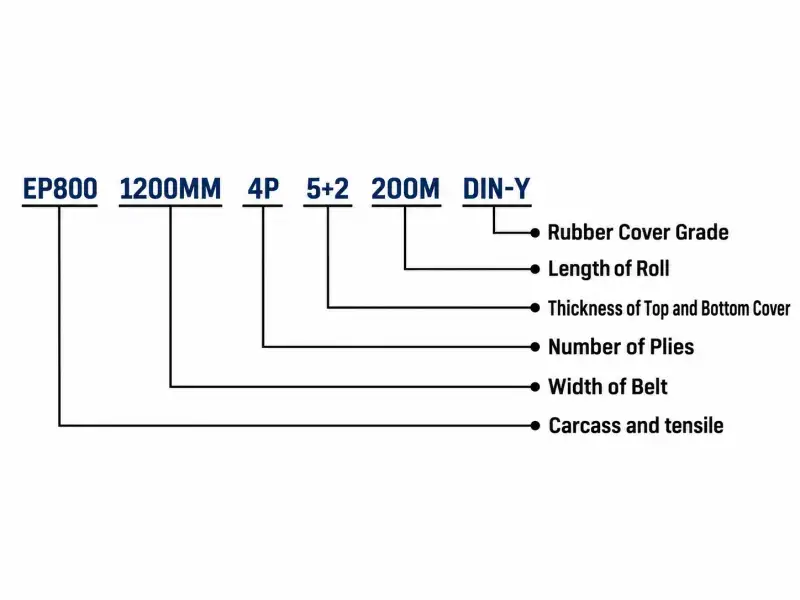
A detailed request for quotation helps suppliers recommend a belt based on evidence instead of assumptions. For a standard fabric-carcass conveyor belt RFQ, eight product specifications are often enough for a supplier to quote with a confirmed specification.
RFQ item | Typical unit or form | What it fixes |
Belt width | mm | Carrying capacity, troughing behavior, roll width, and splice layout |
Total belt thickness | mm | Total finished thickness, checked against pulley diameters and trough angle |
Top cover thickness | mm | The surface that meets the material, so it sets abrasion, cutting, and impact life |
Bottom cover thickness | mm | The surface that runs against the idlers |
Tensile strength | N/mm | Nominal strength of the finished belt, which fixes the ply grade |
Rubber strength | MPa value or grade designation, such as DIN-X or DIN-Y | Separates a standard cover from a high-abrasion or special-duty cover at the same thickness |
Total length | m | Length to be supplied, including allowance for the splice |
Number of fabric plies | Count | Together with the tensile strength, it fixes the ply construction |
Four of the eight items are thicknesses, and they are easy to confuse. Top cover, carcass, and bottom cover add up to the total belt thickness. If you give only the total, a supplier will usually quote equal top and bottom covers, because nothing in the RFQ says otherwise. For an accurate product and an accurate price, state the top and bottom cover thickness separately.
The last two items work as a pair. Tensile strength alone does not fix the construction, because the same N/mm can be built with different ply counts. Ply count alone does not fix it either, because the plies themselves can be made in different grades. Give both.
Rubber strength is the item buyers most often leave out. It describes the cover compound itself, separately from the belt’s tensile strength. Two belts with the same top cover thickness can behave very differently in abrasion service when the compound grade differs.
You do not have to state it as a number. Rubber strength can be given as a measured value in MPa or as a recognized cover grade, such as DIN-X or DIN-Y. A grade designation is often the faster route, because it points to a defined set of cover requirements instead of a single figure, and it is what most suppliers quote against.
If you use a grade designation, name the standard it comes from. If you use a measured value, say which test method produced it, because different methods do not return the same number. In both cases, state which face the compound applies to: top, bottom, or both, since the two covers can be different grades.
If you cannot confirm one of the eight items, mark it as unconfirmed rather than leaving the field empty. A supplier who knows which figure is missing can quote with a stated assumption instead of guessing silently.
8.1 Additional conveyor data to include
- Conveyor center distance and estimated installed loop length;
- Lift, decline, and maximum inclination;
- Belt speed and required capacity;
- Drive arrangement and motor power;
- Take-up type, total travel, usable remaining travel, and operating position;
- Drive, tail, bend, snub, and take-up pulley diameters;
- Idler configuration, trough angle, and transition distances;
- Starting and braking method;
- Calculated running, starting, and maximum tensions if available.
8.2 Material and loading data
- Material name and bulk density;
- Normal and maximum lump size;
- Particle shape and sharpness;
- Loading rate and loading direction;
- Drop height and relative impact velocity;
- Abrasion, cutting, or gouging severity;
- Material temperature and peak exposure;
- Oil, chemical, moisture, or weather exposure;
- Required fire, antistatic, food-contact, or other approvals.
8.3 Existing belt and maintenance data
- Existing belt marking and manufacturer, if known;
- Belt age and achieved service life;
- Splice type and splice failure history;
- Current take-up position and adjustment history;
- Failure location and failure mode;
- Photographs of wear, cuts, edge damage, delamination, or splice damage;
- Any recent change in material, throughput, speed, chute, or operating schedule.
8.4 Commercial and delivery data
- Endless or open belt;
- Required roll lengths and maximum roll dimensions;
- Installation or splicing support requirements;
- Inspection and documentation requirements;
- Delivery location and target date;
- Required packaging, marking, and storage conditions.
9. Technical Evidence to Request From a Supplier
Do not evaluate an EP or NN proposal only from a product name. Ask for a technical data sheet or test certificate covering the exact offered construction.
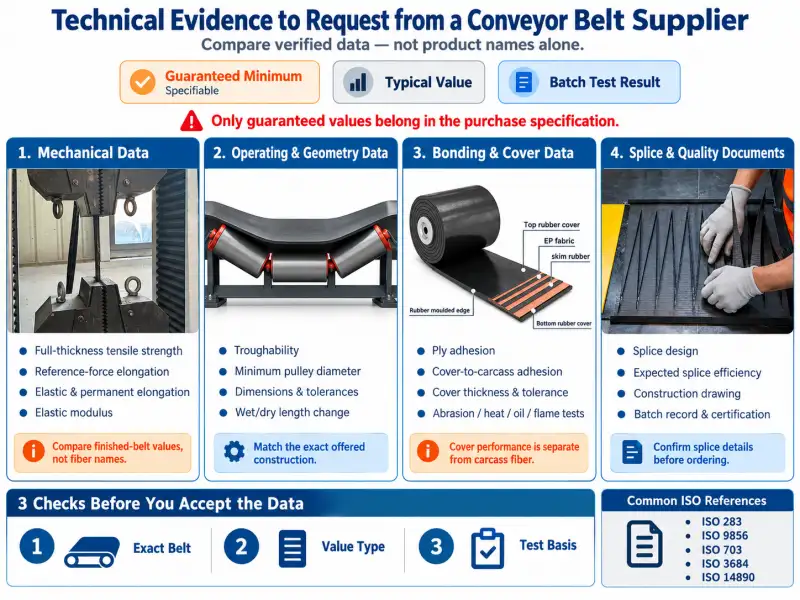
Technical data sheets mix three kinds of numbers, and the three do not carry the same weight:
- Guaranteed minimum:a commitment the supplier can be held to. Only this kind belongs in a specification.
- Typical value:an average from routine production. An individual belt can sit above or below it.
- Batch test result:describes one sample on one day.
When a sheet does not label its figures, ask which kind each one is. The carcass difference sits in exactly the numbers that suppliers most often publish as ranges, so an unlabeled figure is usually where a comparison between two offers stops being reliable.
Evidence group | What to compare between two offers | Which way the carcass pushes |
Elastic and permanent elongation | The actual values, not the fiber names | NN usually higher, and permanent elongation keeps consuming take-up travel |
Elastic modulus | The stiffness figure, against your starting-tension and transition calculation | EP usually stiffer, NN usually softer |
Elongation at break | Read as a property of the carcass, not as take-up demand | NN usually higher, and that alone does not resize your take-up |
Troughability at your trough angle | The value for each offered construction | NN usually more flexible, though thickness and covers can reverse that |
Minimum pulley diameter per position | Each offer against the smallest pulley on the conveyor | NN is often claimed to allow smaller pulleys, so verify per construction |
Ply-to-ply and cover-to-carcass adhesion | Both figures at the condition of use | Not set by the fiber, and a load path for either belt |
Splice structure and expected efficiency | The splice design each offer assumes | A carcass change changes the step design and the achievable efficiency |
Length change between wet and dry | How the length behaves in wet duty | The polyester warp takes up less moisture, so EP length stays more stable |
Top and bottom cover grade and thickness | The cover separately from the carcass | The carcass does not set abrasion, heat, oil, or flame performance |
Six of these nine rows move with the carcass. Three of them decide the choice: elastic and permanent elongation, elastic modulus, and the wet-versus-dry length behavior. Troughability and pulley diameter move with the carcass as well, but the finished construction usually outweighs the fiber, so the number still has to be quoted for your belt. Elongation at break moves with the carcass and still tells you nothing about how much take-up travel you need.
The other three rows protect both belts and are compared side by side. Adhesion, cover grade, and cover thickness come from the compound and the build. If two offers differ there, the difference belongs to the cover, not to the warp.
9.1 Mechanical data
Ask for:
- Full-thickness longitudinal tensile strength of the finished belt, tested on the belt as supplied;
- Elongation at break;
- Elongation at the reference force;
- Elastic elongation;
- Permanent elongation;
- Elastic modulus.
This group is where EP and NN are actually compared, so ask for all six figures against each of the two offers.
Tensile strength is the design figure. It tells you whether the carcass can carry the running tension, and it is the value your conveyor calculation uses. It is also the figure most often quoted as a range across a product family, so confirm it against the ply count and the ply grade in the offer.
Elongation at break looks impressive and is the least useful of the three elongation figures for sizing equipment. It describes how far the carcass stretches before it fails, which is a property of the material rather than a working condition.
Elongation at the reference force is the head-to-head figure. The test applies a reference force related to the nominal belt strength and records the stretch that results, which stays close to what the belt does under normal load. Compare the two offers at the same reference force, then use the result to check take-up travel, transition distance, and starting tension.
Elastic and permanent elongation split that stretch into two parts, and this pair carries most of the EP vs NN decision. Elastic elongation returns when the load is removed. Permanent elongation stays, and it accumulates over the life of the belt, so it consumes take-up travel slowly and permanently.
Elastic modulus converts the same test data into a stiffness figure, and EP carcasses usually return the higher one. Stiffness is what your calculation uses for starting tension and transition behavior, so a higher figure is not automatically better. It has to match the conveyor you have.
A yarn or fabric specification does not settle how the cured belt will behave, so compare only values measured on the finished belt. When you compare an EP offer with an NN offer, also check that both sheets report the same kind of value, since finished-belt strength and per-ply strength are not interchangeable.
9.2 Running and geometry data
Ask for:
- Troughability of the finished belt;
- Minimum recommended pulley diameter for each pulley position;
- Belt dimensions and tolerances;
- Length tolerance;
- Wet-to-dry length change if the belt runs wet.
Both troughability and pulley diameter are measured on the finished belt, so a value quoted for a different construction does not transfer to the belt on your offer.
Troughability describes how readily the belt forms the trough at your idler arrangement, and it depends on the carcass, the cover, and the total thickness together. NN is usually the more flexible carcass, and that is the claim a supplier is likely to make. The claim is worth checking one belt at a time, because the trough is formed by the whole construction rather than by the warp alone.
Minimum pulley diameter comes with a position attached. The drive pulley, the tail pulley, bend pulleys, and the smallest take-up or snub pulley carry different requirements, and the governing one is usually the smallest pulley in the system. NN is often offered as the answer for small pulleys, but the figure follows the construction and the splice type. Ask for it per position on both offers, and compare the numbers rather than the fiber names.
Dimensions and tolerances cover width, length, and thickness. Length tolerance deserves attention on long conveyors, because a belt supplied slightly short can start its service with too little take-up travel left. If the belt runs wet, add one more question: how much does the length change between dry and saturated service? Put that question to both offers, because this growth often appears only after the belt has been running for a while.
9.3 Bonding and cover data
Ask for:
- Ply-to-ply adhesion;
- Cover-to-carcass adhesion;
- Actual top cover thickness and bottom cover thickness, with tolerances;
- Cover compound physical properties;
- Abrasion loss;
- Tensile strength and elongation at break of the cover compound;
- Hardness;
- Heat, oil, flame, or chemical test results where relevant.
This is the group where the EP vs NN question usually does not apply, and stating that plainly is part of the comparison. Adhesion and cover performance come from the construction and the compound, not from the warp fiber.
Adhesion holds the belt together against the forces that try to separate it: flexing over pulleys, impact at the loading point, and the edge stresses of a belt that mistracks. Ply-to-ply and cover-to-carcass are separate tests with separate limits, and a belt can pass one while failing the other.
The two failure patterns look different on a damaged belt, so each figure points at a different risk. Ply-to-ply separation appears as internal delamination near a pulley or after a jam, and it spreads along the belt. Cover-to-carcass separation shows as the cover lifting at an edge, at a splice, or in a strip where the material is discharged. Ask for both figures at the condition closest to your duty: normal, wet, or elevated temperature. Adhesion values are not the same across those conditions.
Cover thickness should be quoted as an actual value with its tolerance, not as a nominal figure alone. On a thin cover, the tolerance is a large share of the wearing material. For wear life, the guaranteed minimum thickness is the number that matters.
Cover compound properties are the measured version of the rubber strength figure you listed in the RFQ: tensile strength, elongation at break, abrasion loss, and hardness of the compound itself. Two covers of the same nominal grade can test differently, and this is the sheet that shows it. Heat, oil, and flame results belong here as well, next to the cover grade and the standard it is measured against.
If two offers differ in this group, changing the carcass will not close the gap. A buyer who switches from NN to EP to solve an abrasion or cover problem has spent money on the wrong variable.
9.4 Splicing and quality documents
Ask for:
- Splice description and splice structure;
- Expected splice efficiency;
- Product construction drawing;
- Batch inspection records;
- Traceability documents;
- Applicable certification.
A carcass change is also a splice change, so this group is where an EP vs NN comparison turns into a project. Two belts of the same nominal strength can still need different splice designs, which means the documents you accept here decide how the joint is built later. Fix the splice design on paper before the order is placed, rather than resolving it on site.
The splice description should state the method, whether hot, cold, or mechanical, the step count and step length, and the direction rule that keeps the warp running along the belt. Direction is not a small detail: a step splice laid out against the warp does not develop the strength of a correctly oriented joint.
Expected splice efficiency is the figure to compare between two offers, because it sets the working tension you can rely on rather than the strength on the label. Ask for it as a percentage of belt strength and ask which splice type it belongs to. An efficiency figure quoted without a splice type cannot be checked, and the step design that achieves it may not match the equipment and the skills at your site.
The product construction drawing is the one document that shows warp and weft direction, ply count, ply grade, cover thickness, and total thickness together. For an EP vs NN decision, it is also the document that shows where the two designs actually part company. It is the reference you check the delivered belt against, so ask for the drawing of the quoted construction rather than a general arrangement for the product family.
Batch inspection records tie the test figures to the batch your belt was produced in. Ask for the report with the batch number, the date, and the individual results, because a summary line without the batch reference cannot be connected to your roll. Traceability documents complete the chain from the delivered roll back to the batch and the incoming material.
Certification should be read for scope and market. A certificate issued for a different belt type, a different cover grade, or a market you do not ship into does not cover your order. Check what the certificate lists, not only that it exists.
9.5 The standards behind these figures
The five standards below are also what makes an EP sheet and an NN sheet comparable at all. Each one defines the same test on the same finished belt, so the resulting figures mean the same thing whoever produced them. Without a named method, one supplier’s elongation and another supplier’s elongation need not be the same measurement, and the comparison falls apart.
- ISO 283:2023: full-thickness tensile strength, elongation at break, and elongation at the reference force.
- ISO 9856:2016: elastic elongation, permanent elongation, and elastic modulus.
- ISO 703:2025: troughability of the finished belt.
- ISO 3684:1990: calculation of minimum pulley diameters.
- ISO 14890:2026: general requirements for rubber- or plastics-covered conveyor belts of textile construction.
The first two standards produce almost the whole EP vs NN comparison. ISO 283 and ISO 9856 are the methods behind the elongation and modulus figures that decide take-up travel. ISO 703 and ISO 3684 are the methods behind the two carcass claims that buyers most often accept without checking.
Add adhesion, tear, cover, or safety tests where the duty calls for them. That extra list is not the same for every belt, so match it to the application instead of copying one standard set onto every order.
Standards set minimum requirements, not targets for your conveyor. A belt that meets every minimum can still be the wrong belt for a long overland incline or for a loading point that receives large lumps. Use the standard to confirm that a figure was produced by a defined method, then use your own calculation to decide whether the figure is good enough.
Three checks turn a data sheet into usable evidence:
- Confirm that the figures describe the belt on offer rather than a catalogue range.
- Separate the guaranteed minimum from the typical value and from the single batch result, because only the first one is a commitment.
- Read the wording closely: “tested according to ISO 283” is not the same statement as “certified to ISO 283,” and a certificate should be checked for what it covers and which market it applies to.
Decide which figures you need as guaranteed values, because every guarantee adds an inspection or a test to the order and suppliers price that work. On a short conveyor with generous take-up travel, permanent elongation is often safe to take as a typical value, and on a long incline it is not.
The same reasoning applies to troughability and to splice efficiency. Ask for guarantees where a wrong figure would stop the conveyor, and accept typical values where the consequence is only a smaller correction.
When two offers sit close together, the guarantee is worth more than the number. A guaranteed elongation figure you can hold a supplier to is a stronger basis for a decision than a slightly better typical value you cannot.
If a supplier cannot provide these items for the belt on offer, treat the gap as a risk. The figures you cannot obtain before the order are usually the same figures that decide the argument after it.
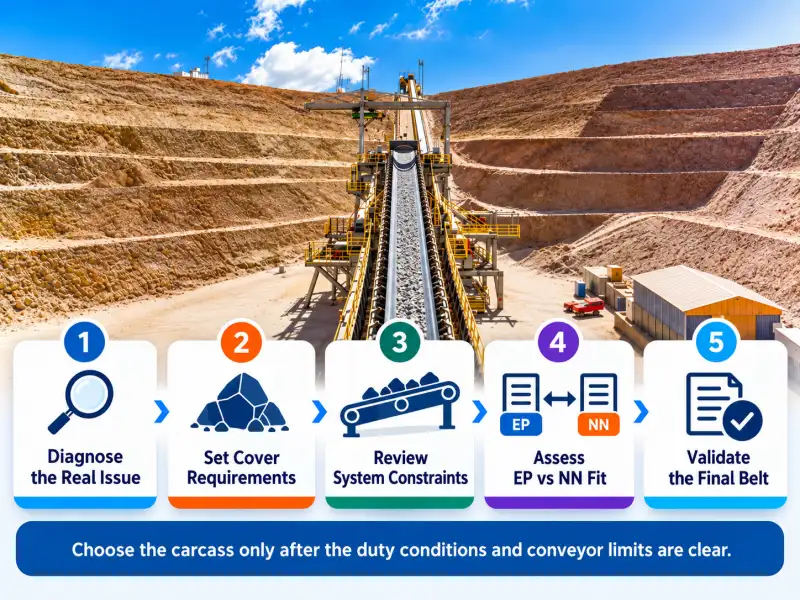
10. A Five-Step Selection Process
10.1 Define the failure or design objective
Decide what you are trying to solve: insufficient belt strength, excessive stretch, take-up exhaustion, impact damage, cover wear, splice failure, tracking instability, or a new conveyor duty. Different problems require different changes.
Start by writing down the failure you are reacting to, in physical terms. “The belt keeps failing” is not a problem statement. “The belt has taken up 400 mm of a 600 mm take-up in six months, and the joint has opened twice” is one, and it already narrows the answer.
The conditions that bring a belt to replacement usually fall into eight groups:
- Insufficient strength, where the belt runs above its allowable working tension;
- Excessive elongation during normal running;
- Take-up travel exhausted;
- Impact damage at the loading point;
- Cover abrasion, cutting, or gouging;
- Splice failure;
- Mistracking;
- Selection for a new conveyor, where no belt has failed yet.
Location and timing separate these groups. Damage concentrated at the loading point points to the material and the chute rather than to the carcass. Damage along the belt or at a pulley, away from the loading point, points to flexing and fatigue. A length problem shows up as a take-up running out, not as a break.
Only three of the eight groups involve the carcass directly: elongation, take-up travel, and the strength question. Cover damage, splice failure, and mistracking belong to the cover, the splice, and the alignment of the structure, and a carcass change repairs none of them.
10.2 Select the required cover performance
Match the top cover to the material and environment. Choose abrasion, cut, heat, oil, chemical, flame, or other resistance based on actual exposure. Specify the necessary cover thicknesses.
The cover answers to the material being carried and to the environment around the belt, not to the fiber in the carcass. Settle it before the carcass comparison, because a cover failure is regularly mistaken for evidence about EP or NN.
Work through the demands your duty places on the rubber:
- Abrasion resistance for hard, sharp, or high-silica material;
- Cut and gouge resistance for large lumps and sharp edges;
- Heat resistance for hot clinker, sinter, coke, or cement;
- Oil resistance for oily or solvent-bearing material;
- Chemical resistance for acidic, alkaline, or otherwise aggressive media;
- Flame resistance where a fire or explosion risk applies;
- Top cover thickness, for the surface that meets the material;
- Bottom cover thickness, for the surface that runs on the idlers.
The two covers are separate decisions. The top cover sees the material, so it carries the abrasion and cutting duty. The bottom cover sees the idlers, so wear there points to slipping, seized idlers, or build-up under the belt rather than to the material being carried. State both thicknesses separately, since a supplier who receives only a total will quote equal covers.
10.3 Calculate strength and system constraints
Determine the required full-thickness belt strength and allowable working tension using the conveyor tensions, duty, safety factor, and splice assumptions. Record the take-up, pulley, trough, and transition limits.
This step turns your conveyor into numbers that a belt either meets or does not:
- Required total finished-belt strength;
- Allowable working tension;
- Safety factor;
- Splice efficiency;
- Available take-up travel;
- Minimum pulley diameter at each position;
- Troughing requirement for your trough angle;
- Transition length from troughed to flat.
Start from the required strength, stated on the finished belt rather than per ply, and confirm it against the ply count and ply grade you are offered. Convert it into allowable working tension by applying the safety factor and the splice efficiency. This is the tension the belt actually has to carry, and it sits well below the nominal value.
Compare elastic and permanent elongation of each offered belt against the take-up travel you have. Include the initial stretch after installation, and include the wet-to-dry length change if the belt runs wet.
Check the minimum pulley diameter for every position against the smallest pulley in the system, then check the transition length. Check the troughing requirement against the troughability quoted for your trough angle.
Step three is where EP and NN separate. An EP belt usually demands less travel and holds its length better. An NN belt usually demands more, and permanent elongation keeps consuming travel after commissioning. If your take-up has no margin left, the NN option is eliminated here, on arithmetic, before anyone discusses its genuine advantages in impact and flexing.
10.4 Compare EP and NN behavior
Choose EP as the starting point when lower elongation and stable length are central. Consider NN when dynamic elasticity and repeated impact or flexing are central and the take-up system can support the expected elongation.
Where low elongation, stable length, and limited take-up travel dominate, start from EP. Where elasticity, repeated flexing, and dynamic impact dominate, evaluate NN. Where both sets of demands exist, design the complete belt and the loading system instead of choosing between two fiber names.
A long conveyor with a severe loading zone needs two decisions rather than one: a loading zone that reduces the impact reaching the belt, and a carcass that carries the tension without consuming take-up travel. Selecting NN usually addresses the second decision only, and it charges the take-up for the entire life of the belt.
Each carcass also carries a cost that appears in a different place. NN buys its impact behavior with take-up travel, which has to be available for years. EP buys its length stability with stiffness, which shows up at small pulleys and short transitions. Compare those two costs against your installation rather than comparing the two names.
When both options clear every earlier step, the tie-breaker is field evidence. A construction that has run well on that conveyor, with no change in duty, is a lower-risk choice than a technically stronger option that has never run there.
10.5 Validate the exact offered belt
Check test values, dimensions, pulley guidance, troughability, splice procedure, cover grade, and documentation for the exact construction. For a substitution, obtain technical approval before ordering.
Approving a carcass type is not the same as approving the belt you will receive. Check:
- Actual test data for the offered belt;
- Belt dimensions and tolerances;
- Ply structure, including ply count and ply grade;
- Cover grade, and actual top and bottom cover thickness;
- Pulley requirements;
- Troughability;
- Splice plan;
- Inspection and certification documents.
The first group confirms the calculation. Test data settles strength, elastic elongation, permanent elongation, and modulus. Dimensions and tolerances confirm the belt fits and that the length allowance suits the take-up rather than consuming it. Ply structure confirms the strength you are paying for, and it sets the splice design that follows from it.
The second group confirms the duty. Cover grade and actual cover thickness answer the requirements set in 10.2, with thickness tolerance carrying as much weight as the nominal figure. Pulley requirements confirm the belt suits every position, not only the largest pulley.
The third group covers the joint and the paper trail. The splice plan fixes the step design, the press capacity, and the skill needed on site. Inspection and certification documents confirm that the test figures can be traced to your batch, and that any certificate covers the belt type and the market you operate in.
A step is complete when the document exists. A verbal answer that NN is fine on small pulleys is not validation, and neither is a catalogue page. Compare the two offers on the same items, in the same units, and with the same guarantee status, so that a guaranteed minimum on one sheet is not weighed against a typical value on the other.
11. Final Recommendation
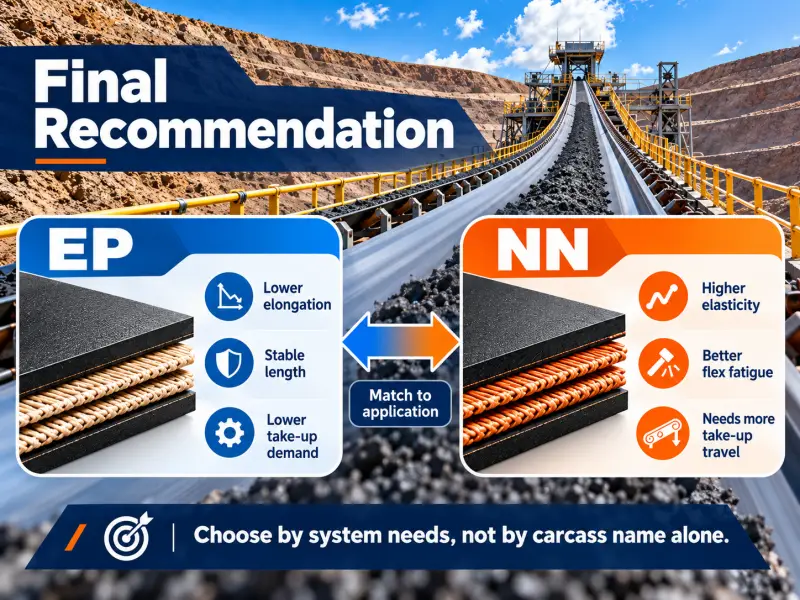
The most useful distinction is straightforward:
- Choose EP as your starting preferencewhen you need lower longitudinal elongation, greater dimensional stability, reduced take-up demand, or predictable operation on long and high-tension conveyors.
- Consider NNwhen you need greater elasticity and fatigue resistance under repeated impact or flexing, and your take-up and conveyor geometry can accommodate its higher stretch.
Do not decide from these tendencies alone. Neither carcass is universally stronger, more abrasion-resistant, more heat-resistant, cheaper, or longer-lasting. The correct belt combines the required carcass strength and elongation behavior with suitable covers, dimensions, splice, pulley compatibility, and loading-zone design.
If you are replacing an existing belt, start with its full marking and operating history. If the old construction performed well, matching it usually reduces risk. If it failed early, identify the failure mechanism before changing EP to NN or NN to EP. That approach gives you a specification that solves the actual problem instead of transferring it to another part of the conveyor.
12. Frequently Asked Questions
12.1 Are EP 500/4 and NN 500/4 directly equivalent?
No. They may share the same nominal full-thickness tensile rating and ply count, but their longitudinal elongation, modulus, permanent growth, troughability, thickness, pulley requirements, and splice instructions can differ. Confirm that the rating uses the same convention, then review take-up, tension, pulley, trough, cover, and splice compatibility.
12.2 Does an NN conveyor belt always need more take-up travel?
An NN belt generally has higher longitudinal elongation than a comparable EP belt, so it will usually require more take-up allowance. The actual requirement must be calculated from the exact belt data, installed length, operating tension, permanent growth, splice allowance, temperature, and take-up geometry.
12.3 Which belt is better for small pulleys?
There is no automatic winner. NN is often flexible, but the minimum pulley diameter depends on the finished belt’s strength, thickness, ply construction, covers, splice, and pulley duty. Use the manufacturer’s diameter table or an approved calculation for the exact belt, and check every pulley position against the smallest pulley in the system.
12.4 Which belt is better for rock, ore, or other abrasive material?
Either carcass may be suitable. Abrasion and cutting are primarily handled by the cover compound, cover thickness, and loading-zone design. Choose carcass type according to strength, elongation, impact, take-up, and system requirements, then specify the appropriate wear-resistant cover.
12.5 Can an EP belt handle high-impact loading?
Yes, when the complete belt and loading system are designed for it. EP already includes nylon in the transverse direction. Carcass construction, belt strength, top cover, breaker reinforcement, chute trajectory, impact bed, drop height, and lump shape all influence impact performance. NN absorbs impact through elasticity, but it spends take-up travel for the life of the belt.
12.6 Can an EP belt be spliced directly to an NN belt?
This should not be treated as a standard direct splice. Even when the two belts have the same width and nominal strength, differences in elongation, modulus, thickness, and ply construction can create uneven loading around the splice. A transition splice should only be used when it has been designed and approved for the two exact belt constructions. For a permanent installation, using one compatible carcass construction throughout the belt loop is generally more reliable.